戍
Character Story & Explanation
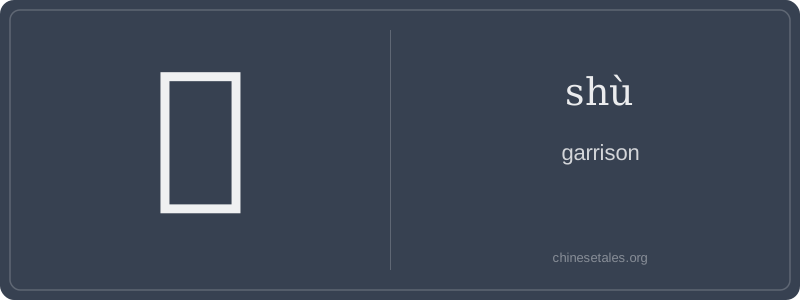
The earliest form of 戍 appears in Western Zhou bronze inscriptions: a clear pictograph showing a person (亻) standing beside a weapon — specifically the 戈 (gē), a halberd-like polearm. Over centuries, the person simplified into the left-side radical 亻 (ren, ‘person’), while the right side evolved from a full 戈 + a horizontal stroke representing ‘land’ or ‘border’ into today’s 戊 (wù) — a shape that originally signified ‘military authority’ and later became one of the Heavenly Stems. Crucially, the modern 戍 is *not* 戊 (wù) alone — it’s 亻 + 戊, visually encoding ‘a person bearing military authority at the border’.
This visual logic shaped its meaning: from ‘stationing armed personnel at strategic terrain’ in oracle bone records, to ‘maintain permanent garrisons’ in Warring States texts like the *Zuo Zhuan*, where ‘戍郑’ meant ‘garrison Zheng territory’. By Tang dynasty poetry, 戍 had crystallized into a poetic shorthand for frontier sacrifice — soldiers stationed far from home, their loyalty measured in years, not hours. Its six-stroke simplicity belies a profound geopolitical weight: every stroke anchors us to land, weapon, and human resolve.
Picture a windswept watchtower on the Great Wall at dawn — not tourists snapping selfies, but a lone soldier standing rigid, spear in hand, scanning the northern horizon. That’s 戍 (shù): not just ‘to guard’, but to *garrison* — to station troops permanently in a strategic, often remote, outpost. It carries weight, duty, and quiet endurance. You won’t hear it in casual chat; it’s literary, historical, or bureaucratic — think military reports, classical poetry, or official documents about border defense.
Grammatically, 戍 is almost always a verb, and it’s nearly always followed by a location: 戍边 (shù biān, ‘garrison the frontier’), 戍守 (shù shǒu, ‘hold/defend a post’). It rarely stands alone — you wouldn’t say ‘I 戍’ like ‘I run’. It’s also never used for temporary guarding (that’s 看守 or 守卫); 戍 implies institutional, long-term military presence. Learners sometimes misread it as ‘to punish’ (confusing it with 诛 or 刑) — but no: this character is about vigilance, not vengeance.
Culturally, 戍 evokes China’s millennia-old frontier consciousness — the tension between agrarian heartland and nomadic steppe, embodied in poems like Wang Changling’s ‘Leaving the Frontier’: ‘秦时明月汉时关,万里长征人未还’ (‘The moon of Qin, the pass of Han — ten thousand li of campaign, and still no return’). The character itself is rare in modern spoken Mandarin, so encountering it feels like stepping into a scroll painting — solemn, deliberate, and deeply rooted in statecraft.