戛
Character Story & Explanation
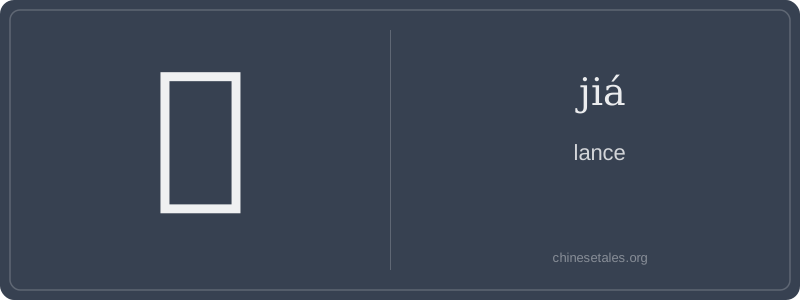
The earliest form of 戛 appears in late Shang oracle bones and Zhou bronze inscriptions as a simplified pictograph: a vertical line (representing the shaft), topped by a sharp, angular ‘V’ or ‘<’ shape (the tapered blade), and anchored at the base by a small horizontal stroke — all unmistakably evoking a slender, pointed lance. Over centuries, the top evolved into the current 戋 component (two crossed strokes + a dot), while the bottom solidified into the 戈 (‘dagger-axe’) radical — not because it’s a dagger-axe, but because scribes associated all elite polearms with this prestigious weapon radical. The 11 strokes crystallized by the Han dynasty: three for 戋 (two slashes + dot), eight for 戈 (including the sweeping hook).
This character wasn’t born on the battlefield — it was forged in the scriptorium. Early texts like the Zuǒ Zhuàn (c. 4th c. BCE) mention 戛 alongside ritual weapons used in ancestral ceremonies, suggesting its lance wasn’t just for war but also for symbolic authority. By the Han, its meaning narrowed to denote a specific ceremonial lance carried by high-ranking officers during imperial inspections. Its visual austerity — clean lines, sharp angles — mirrors its semantic precision: not ‘weapon’ generically, but *the* lance that cuts decisively through noise, confusion, and distance.
Imagine a bronze-age battlefield at dawn: a warrior grips a long, slender lance — not the heavy halberd (戈) but a lighter, sharper thrusting weapon with a narrow blade and pointed tip. That’s 戛 (jiá): not just any spear, but a *refined*, almost elegant lance used for precision strikes. In classical Chinese, it evokes martial grace and lethal efficiency — think of a Tang dynasty cavalryman piercing armor with a single, clean motion. It’s never used alone in modern speech; you’ll only meet it in literary or historical contexts, like poetry or historical novels.
Grammatically, 戛 appears almost exclusively as a noun, often paired with other weapons (e.g., 戛戟) or in set phrases describing combat. You won’t say ‘I hold a 戛’ — instead, it surfaces in descriptive passages: ‘the sound of 戛 striking metal’ or ‘a 戛 flashing under moonlight’. Learners mistakenly treat it like common nouns (e.g., trying to pluralize it or use it with measure words like 个), but it resists colloquial grammar — it’s fossilized in literary diction, like ‘spear’ in English epic poetry.
Culturally, 戛 carries an air of archaic prestige — it’s the kind of word that appears in the Shuōwén Jiězì (121 CE) and echoes in Song dynasty military manuals, yet vanished from daily use by the Ming era. A common mistake is misreading its radical (戈) as implying general ‘weapon-ness’, when in fact 戛 specifically denotes *one rare type* of lance — distinct from 戟 (halberd), 槊 (cavalry spear), or 矛 (standard spear). Its rarity means even native speakers pause before using it — and many would double-check a dictionary first.