捌
Character Story & Explanation
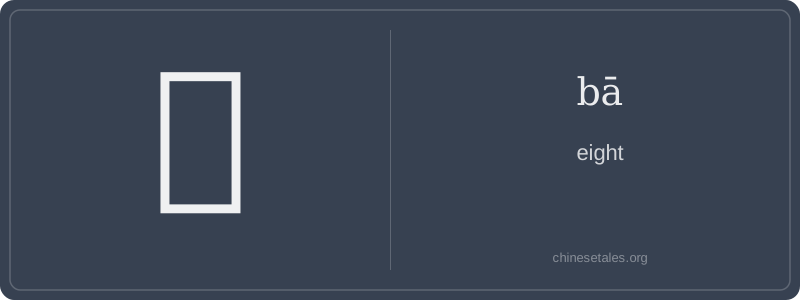
The earliest form of 'eight' was the simple oracle bone character 八 — two diverging lines, like hands parting or paths splitting — symbolizing separation or duality. But by the Warring States period, scribes began embellishing numerals for legal clarity. 捌 emerged as a deliberately complex variant: starting from 八, they added the hand radical 扌 on the left (signifying human action), then elaborated the right side into 匕 + 廴 — not a pictograph of anything real, but a visual 'lock' against alteration. Its ten strokes were chosen for density and uniqueness: too many to add or erase casually, unlike the three-stroke 八.
This wasn’t poetic evolution — it was bureaucratic innovation. The earliest surviving example appears in Qin dynasty bamboo slips recording grain disbursements, where clerks used 捌 alongside 壹 and 贰 to prevent fraud. In the Shuōwén Jiězì (121 CE), Xu Shen classified it under 扌, explicitly noting its function as 'the formal script for 八 in accounting'. Visually, the hand radical doesn’t mean 'to grab eight' — it means 'hand-written with intention': this eight was *placed*, not counted. Its weight comes not from meaning, but from institutional trust.
Think of 捌 as Chinese financial 'Helvetica Bold' — not the everyday number you count on your fingers, but the bank-teller version of 'eight', designed to prevent forgery like a medieval scribe’s anti-fraud flourish. While 八 (bā) is the simple, elegant numeral we use in speech and text, 捌 is its stern, ink-heavy cousin reserved for checks, contracts, and official ledgers — where someone might otherwise sneak in an extra stroke to turn '8' into '10' or '30'. It carries no new meaning: it *is* eight, full stop — just dressed in formalwear.
Grammatically, 捌 functions only as a numeric character in formal written contexts; you’ll never say 'bā' while reading it aloud in a contract — you still pronounce it bā, but you *write* it as 捌 to block tampering. You won’t find it in 'eight people' (八个人) or 'Chapter Eight' (第八章); those use 八. Instead, it appears exclusively in phrases like '¥捌佰元整' (RMB 800 exactly) — always with other formal numerals (壹、贰、叁…), never alone, never in conversation.
Culturally, learners often mistakenly write 捌 on homework or flashcards thinking it’s 'a more advanced eight' — but it’s not advanced, it’s *administrative*. Using it outside finance/legal contexts feels like wearing a tuxedo to order coffee. And yes — mixing it up with 八 is one of the most common handwriting blunders in beginner calligraphy exams: the radical 扌 (hand) hints at *human intervention*, i.e., deliberate, careful writing — not counting, but *certifying*.