掼
Character Story & Explanation
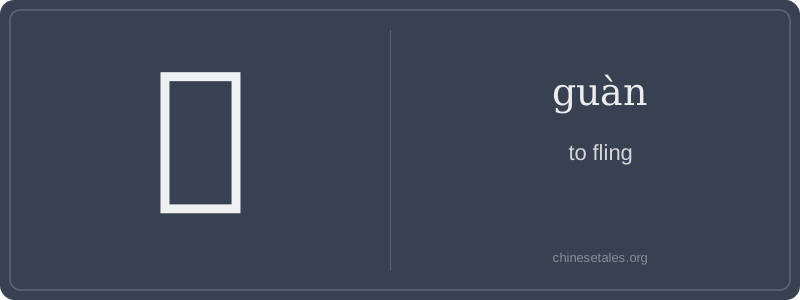
The earliest form of 掼 appears in late Han bamboo slips and Tang dynasty variant scripts — not oracle bone, but close enough in spirit. Its left side 扌 (hand radical) anchors the action, while the right side 段 (duàn) originally depicted a sectioned piece of wood or metal — think of a segmented club or a cut log. Over centuries, the right-hand component simplified from 段 to 貫 (guàn, ‘to pierce through’) and finally stabilized as the modern 段-like shape we see today — a visual echo of something *driven through* or *slammed down* with full arm motion.
This evolution reflects meaning expansion: from ‘striking forcefully with a segmented weapon’ in military texts (e.g., Tang-era martial manuals describing 掼棍 — ‘flinging a staff’ in combat drills) to broader vernacular use by the Ming-Qing period, where it entered storytelling slang for ‘to discard decisively’ or ‘to hurl with expressive abandon’. The character’s very structure — hand + segmented weight — makes its core idea physically legible: you don’t just let go; you commit your whole forearm and shoulder to the fling.
Think of 掼 (guàn) as Chinese’s answer to the dramatic, slightly reckless gesture of slamming your coffee cup down after a heated argument — not quite breaking it, but making sure everyone hears the point. It’s not just ‘to throw’ like 投 (tóu) or 扔 (rēng); 掼 implies forceful, abrupt, often emotional flinging — a phone onto a sofa in frustration, keys onto a table with finality, or even a punch thrown in a folk opera. It carries weight, intention, and sometimes theatrical flair.
Grammatically, 掼 is almost always transitive and pairs with concrete, often heavy or symbolic objects: 掼手机 (guàn shǒujī), 掼门 (guàn mén), 掼扑克牌 (guàn pūkèpái). It rarely stands alone — you won’t say ‘He 掼’d’ without specifying *what* was flung. Also, it’s nearly never used for gentle or precise actions (no 掼 a feather or 掼 a kiss!). Learners often mistakenly use it where 扔 or 丢 would be more neutral — but 掼 adds a layer of impatience, anger, or decisive closure.
Culturally, 掼 thrives in northern dialects and oral storytelling — especially in folk performances and regional opera, where exaggerated physical gestures punctuate emotion. It’s conspicuously absent from formal writing and HSK materials because it’s vividly colloquial, almost onomatopoeic: the ‘guàn’ sound itself mimics the thud or thump of impact. Mistake it for a literary or polite verb, and you’ll sound like someone shouting stage directions in a boardroom.