摠
Character Story & Explanation
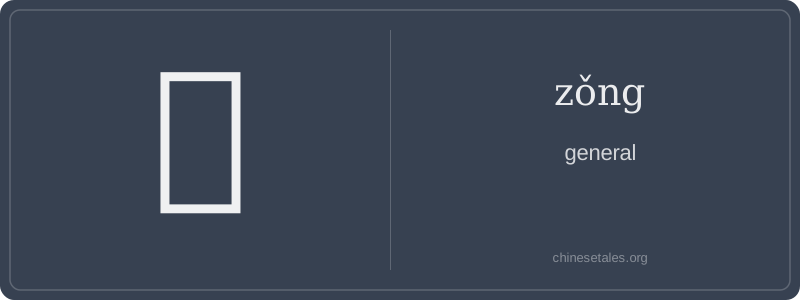
The earliest attested form of 摠 appears in Song dynasty printed editions and late Tang manuscript variants — not oracle bones or bronzes. It evolved from 總 via a stylized clerical script simplification: the top component changed from 糸 (silk threads, implying 'binding together') to 艹 (grass radical, here acting purely phonetic), while the bottom retained 恭 (gōng, 'respectful, reverent'), preserving both sound and connotation of solemn oversight. Visually, it’s a hybrid: the grass radical hints at organic growth and comprehensiveness (like grass covering ground), while 恭 anchors it in ritual gravity — suggesting 'binding with reverence'.
This character crystallized during the Northern Song when scholars like Ouyang Xiu compiled massive historical syntheses. In the *New History of the Tang Dynasty*, 摠 appears in phrases like 摠而論之 ('summing up and speaking thus'), marking editorial authority. Unlike 總, which drifted toward administrative meanings ('head of department'), 摠 retained its classical flavor — a linguistic heirloom used only when invoking scholarly synthesis. Its visual quirk — grass atop reverence — subtly echoes Confucian ideals: wisdom grows organically, yet demands humility and rigor.
Imagine you’re at a Ming dynasty imperial archive, where scribes rush to compile the 'Complete Annals of the Reign' — not just listing events, but weaving them into one unified narrative. That’s 摠 in action: it doesn’t mean 'general' as in 'vague' or 'broad', but 'comprehensive, all-encompassing, synthesized'. It carries weight — like a master editor stitching fragments into a coherent whole. In classical and literary Chinese, 摠 functions almost exclusively as a verb meaning 'to summarize, synthesize, or oversee in totality' (e.g., 摠其大要 — 'sum up its essential points').
Grammatically, it’s almost never standalone in modern speech; you’ll find it only in formal compounds, classical allusions, or stylistic archaisms — never in HSK-level conversation or casual writing. Learners mistakenly treat it like the common 總 (zǒng), using it in phrases like *摠管* or *摠結*, but those are incorrect: the standard simplified form is 總, and 摠 is a rare, obsolete variant. Its presence signals deliberate literary flair — like quoting Shakespeare instead of texting.
Culturally, 摠 is a ghost character: it appears in Song-Yuan stele inscriptions, Ming encyclopedias, and Qing scholarly prefaces, always evoking authority, synthesis, and meticulous curation. Mistaking it for 總 won’t break comprehension, but it reveals your text isn’t contemporary — and might raise an eyebrow among native editors. Its rarity means even many native speakers pause before reading it aloud, recalling its weighty pedigree rather than its sound.