摷
Character Story & Explanation
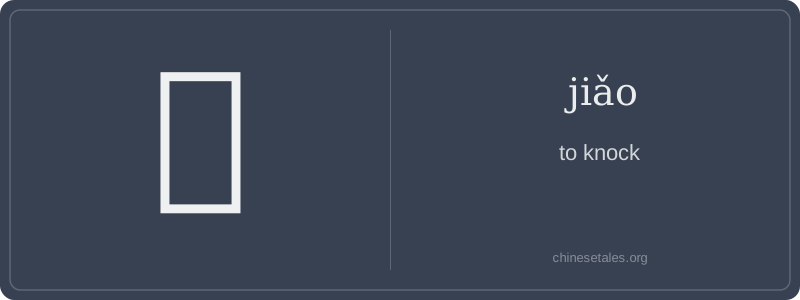
The earliest form of 摲 appears in bronze inscriptions of the Western Zhou dynasty (c. 1046–771 BCE) as a composite glyph: the left side was 手 (hand, later simplified to 扌), and the right was 交 — not just 'to intersect', but originally a pictograph of crossed legs in a seated, grounded posture, symbolizing stability and controlled action. Over centuries, the hand radical solidified into its standard left-side form, while 交 evolved from crossed limbs into its modern angular shape. Crucially, no oracle bone form survives — this character emerged fully formed in ritual bronze contexts, suggesting it was coined for ceremonial precision, not everyday use.
By the Warring States period, 摲 appeared in texts like the *Guoyu* (Discourses of the States) describing officials ‘tapping the desk’ to command silence — a gesture rooted in bodily control and hierarchical awareness. Its meaning never broadened; unlike 敲, which absorbed meanings from drumming, hammering, and even metaphorical 'striking' (e.g., 摇头晃脑), 摲 stayed narrow and dignified. Even in Tang poetry, it appears only in scenes of scholarly composure or judicial solemnity — always with a sense of calibrated impact, never violence or haste.
At first glance, 摲 (jiǎo) feels like a quiet, almost forgotten verb — it means 'to knock' or 'to tap', but not the loud, urgent kind you'd use on a door. Think more of a gentle rap with knuckles on wood, a rhythmic tap to get attention, or even the soft thud of a gavel in a traditional courtroom. It’s tactile and deliberate, carrying a sense of measured authority or ritual precision — far from the casual 'knock-knock' of English. You’ll rarely hear it in everyday speech today; it’s mostly preserved in classical idioms, literary descriptions, or formal compound words.
Grammatically, 摲 is a transitive verb that usually takes a concrete object: 摲门 (jiǎo mén, 'tap the door'), 摲案 (jiǎo àn, 'tap the desk'). Unlike modern colloquial verbs like 敲 (qiāo), which dominates in spoken Mandarin for all kinds of knocking, 摲 implies restraint and intention — no shouting, no force, just focused contact. Learners often mistakenly substitute it for 敲 or 打, but doing so sounds archaic or overly theatrical, like quoting Confucius at a coffee shop.
Culturally, 摲 reflects an ancient Chinese aesthetic of understated power: influence conveyed not through volume or force, but through timing, rhythm, and physical resonance. In classical texts, magistrates would 摲案 to signal order; scholars would 摲几 (tap the low table) to punctuate a point in debate. The biggest pitfall? Assuming it's interchangeable with common verbs — it’s not. Its rarity makes it a linguistic time capsule, not a functional tool for daily conversation.