掺
Character Story & Explanation
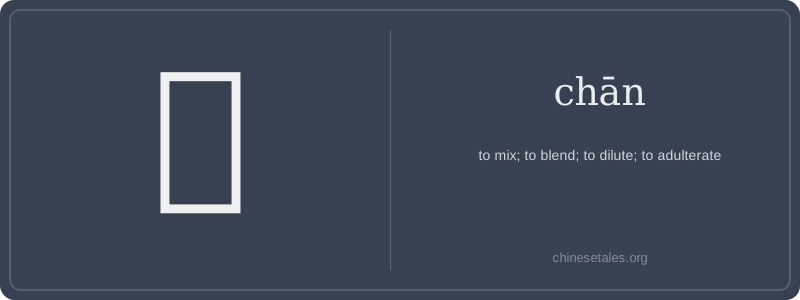
The earliest form of 掺 appears in Warring States bamboo slips as a hand (手) gripping a stalk-like shape — possibly representing grain or fibers being drawn in and folded. Over centuries, the hand simplified into the standard 扌 radical on the left, while the right side evolved from 炎 (flame, suggesting heat-induced blending?) into today’s 参 (cān), which originally depicted three people standing together — a visual metaphor for *bringing elements into shared presence*. By the Han dynasty, the character had stabilized into its current 11-stroke structure: three horizontal strokes (一), a vertical hook (丨), then the intricate 参 component with its three dots and crossbar — all echoing the idea of interweaving distinct parts.
This evolution mirrors its semantic journey: from concrete manual mixing (stirring herbs in medicine) to abstract blending (ideas, identities, even lies). In the *Book of Rites*, 掺 appears in ritual contexts describing how sacrificial offerings were prepared — each ingredient deliberately incorporated, never merely placed beside another. The visual tension between the active hand and the complex, multi-layered 参 reminds us: true blending isn’t flattening — it’s holding difference in dynamic relation. That’s why 掺 feels more intimate than 加 (jiā, ‘to add’) and more intentional than 合 (hé, ‘to join’).
Think of 掺 (chān) as the ‘hands-on mixer’ of Chinese verbs — it’s never passive. That 扌 (hand) radical isn’t just decoration; it tells you this action requires physical, deliberate contact: stirring batter, folding dough, even slipping counterfeit notes into a cash bundle. It implies *intentional* blending — not accidental mixing, and certainly not just ‘being together.’ So while 混 (hùn) means ‘to mix up’ (often messily or chaotically), 掺 always carries agency and control.
Grammatically, it’s a transitive verb that takes a direct object — and crucially, it often appears in resultative or compound constructions like 掺和 (chān huo) or 掺假 (chān jiǎ). You’ll hear it in kitchens (‘掺点水’ — ‘add some water’), markets (‘这米里掺了沙子’ — ‘sand has been mixed into this rice’), and ethics discussions (‘不能掺水分’ — ‘don’t dilute with filler’). Learners often mistakenly use it where English says ‘combine’ or ‘include’ — but 掺 implies *altering composition*, not just adding an element.
Culturally, 掺 carries subtle moral weight: 掺假 (adulteration) is a serious accusation — think fake milk powder or diluted fuel. Even in cooking, 掺 too much water suggests laziness or cutting corners. And yes — there’s that rare shǎn reading (in classical texts like the *Zuo Zhuan*), meaning ‘to grasp suddenly,’ but for modern learners, chān is 99.9% of your need. Don’t overthink the shǎn — just file it under ‘linguistic fossil.’