撅
Character Story & Explanation
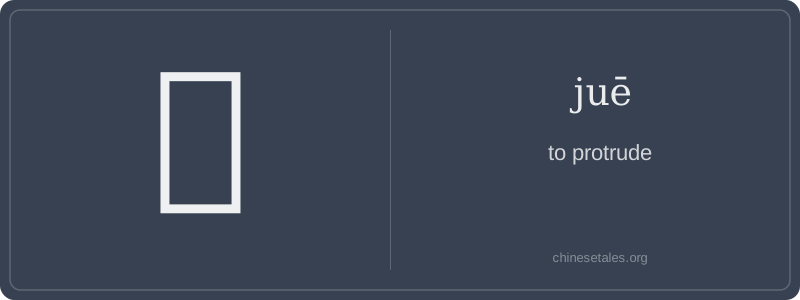
The earliest form of 撅 isn’t found in oracle bones, but its structure reveals ancient logic: left side 扌 (hand radical) signals action; right side 虍 (hū, tiger head) + 宜 (yí, proper) evolved into the modern 厥 (jué), originally depicting a person kneeling with hands bound, then later signifying ‘to lift up’ or ‘to rise abruptly’. Over centuries, the tiger-head element simplified, and the lower part merged into 厥 — a phonetic component hinting at pronunciation while retaining the sense of forceful upward motion. Visually, the 15 strokes build like a hand (扌) gripping and *wrenching* something upward — the three horizontal strokes in 厥 mimic taut tendons pulling against resistance.
This visual tension mirrors its semantic journey: in classical texts like the *Shuōwén Jiězì* (c. 100 CE), the precursor 厥 meant ‘to cut off’ or ‘to sever’, implying abrupt separation — which naturally extended to ‘jutting out’ as a kind of physical severance from the surrounding surface. By the Ming-Qing vernacular novels, 撅 appeared frequently describing defiant postures: a servant ‘撅着屁股’ (juē zhe pìgu) to avoid a scolding, or a scholar ‘撅着下巴’ (juē zhe xiàbā) in haughty dismissal. The character never lost its edge — it’s the linguistic equivalent of a raised eyebrow and a stiffened jaw.
Imagine a stubborn mule on a dusty road in rural Sichuan — ears pinned back, nostrils flared, and its tail jutting stiffly upward like a tiny flag of defiance. That’s 撅 (juē) in action: not just ‘protruding’ in a neutral physical sense, but doing so with attitude — sharp, abrupt, often slightly rebellious or awkward. It describes things thrusting out *against expectation*: a chin jutted in anger, lips pouted in sulking, a branch sticking out crookedly from a fence, or even a tongue stuck out playfully. It’s visceral, bodily, and almost always implies tension or imbalance.
Grammatically, 撅 is almost always used as a verb in the pattern ‘subject + 撅 + object/direction’, often followed by directional complements like 出来 (chūlái) or 起来 (qǐlái). You’ll hear it in colloquial speech more than formal writing: ‘他撅着嘴’ (tā juē zhe zuǐ) — ‘He’s pouting’ — where 撅 carries the full weight of sullen facial posture. Crucially, it’s rarely used for smooth, graceful protrusion (that’s 突出 tūchū); learners often overgeneralize it to mean any ‘stick out’, but 撅 always hints at rigidity, resistance, or childishness.
Culturally, this character thrums with folk expressiveness — it appears in regional opera gestures, children’s rhymes, and dialect storytelling, where body language conveys emotion louder than words. A common mistake? Confusing it with the much more neutral 突 (tū) or misreading the 扌 radical as passive — remember: this hand is *pushing*, not holding. Also, never use it for abstract concepts like ‘stand out’ in achievements; that’s 突出 or 显眼. 撅 lives in the realm of the physical, the petulant, and the delightfully unrefined.