挦
Character Story & Explanation
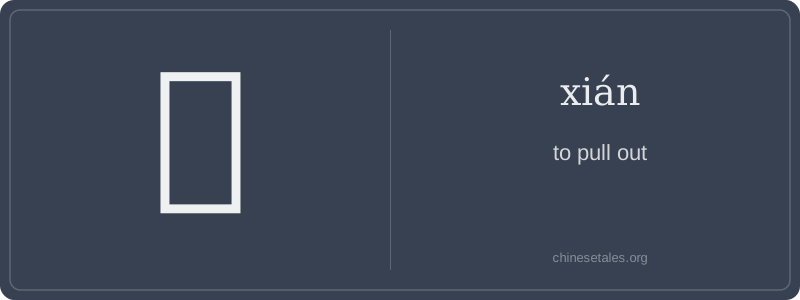
The earliest form of 挦 appears in bronze inscriptions as a composite: a hand (扌) gripping a stylized tuft of hair or grass (彡), which originally looked like three flowing strokes representing strands being wrenched upward. Over centuries, the hair element evolved into the top component 闲 (xián), but crucially — this isn’t the common character 闲 (leisure); it’s a phonetic loan shape borrowed for sound, not meaning. The hand radical remained anchored at left, while the right side stabilized into today’s 闲-like form, though ancient forms clearly show fingers twisting and pulling fibrous material.
This visual origin directly shaped its semantic path: from literal hair-pulling in Zhou dynasty ritual texts (e.g., ‘挦发祭神’ — tearing hair as offering) to metaphorical force in Tang poetry (Li Bai’s line ‘挦云裂石’ — ripping clouds, splitting stone) and Ming fiction where villains ‘挦耳揪鼻’. Even today, when writers want raw physicality — not just removal, but violent, defiant extraction — they reach for 挦. Its persistence across millennia testifies to how precisely Chinese script can encode gesture and grit.
At its core, 挦 (xián) is a vivid, almost visceral verb meaning 'to pull out' — not gently plucking a flower, but yanking something stubbornly, often with force and resistance: hair, weeds, teeth, or even abstract things like truth from silence. It’s emphatic, physical, and slightly archaic — you’ll rarely hear it in casual speech today, but it appears with punch in literary prose, historical texts, and classical poetry where intensity matters. Think of it as the Chinese equivalent of 'wrench,' 'rip out,' or 'tear free.'
Grammatically, 挦 functions as a transitive verb and usually requires an object (e.g., 挦草, 挦毛). It doesn’t take aspect markers like 了 or 过 as readily as common verbs — its weight makes it feel complete on its own. Learners sometimes misread it as xiǎn (confusing tone) or overuse it like 拔 (bá), but 拔 implies clean extraction (拔萝卜), while 挦 suggests rough, uneven, or even painful removal (e.g., 挦断几根眉毛). It’s also never used for abstract 'pulling' like data or ideas — that’s 提取 or 获取.
Culturally, 挦 carries a faintly rustic, even combative flavor — it appears in Ming-Qing vernacular novels describing brawls (‘挦住衣领’ — grabbed and yanked the collar), herbal texts (‘挦取根茎’ — tear up roots), and modern essays criticizing censorship (‘挦去真相’ — rip away the truth). A classic learner trap: seeing the 扌 radical and assuming it’s a simple ‘hand action’ verb — but 挦 isn’t everyday; it’s deliberate, dramatic, and loaded with tactile tension.