撧
Character Story & Explanation
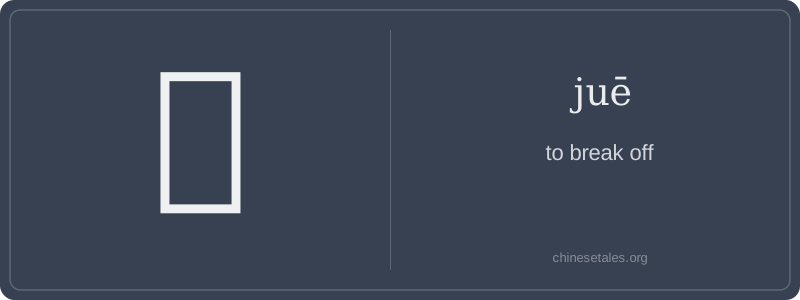
The earliest form of 撧 doesn’t appear in oracle bones — it’s a late-developing character, first reliably attested in Ming dynasty vernacular texts. Its structure tells the tale: left side 扌 (shǒu, 'hand radical') signals manual action; right side 屈 (qū, 'to bend, bow') is both phonetic (approximating juē) and semantic — bending *so far* that rupture occurs. Visually, the modern form combines hand + bending + a subtle 'downward pressure' cue in the final stroke’s hook, suggesting torque applied until failure. No ancient pictograph survives, but the component logic is brilliantly kinetic: *hand forces something bent until it breaks.*
Historically, 撧 emerged alongside vernacular fiction and technical manuals — think farming guides or carpentry treatises — where precise verbs for physical labor were essential. It never entered classical literary diction (you won’t find it in the Analects or Tang poetry), but thrives in regional speech: Shandong farmers say 撧麦秆 (juē mài gǎn, 'snap wheat stalks'), Beijing elders warn kids not to 撧电线 (juē diàn xiàn, 'yank live wires'). Its meaning stayed remarkably stable: always involving *manual force*, *a linear object*, and *sudden, irreversible separation*. Even today, if you see someone twist and jerk a branch downward and hear a sharp crack — that’s 撧.
At its core, 撧 (juē) isn’t just ‘to break off’ — it’s the visceral, almost violent snap of something brittle and stubborn: a dry twig, a frayed rope, or even someone’s patience. It carries a sense of finality and physical resistance overcome — not gentle separation like 分开 (fēn kāi), nor abstract cessation like 停止 (tíng zhǐ). In speech, it’s heavily colloquial and often used with objects that *resist* breaking (e.g., 撧断, 撧下来), and almost always implies manual force applied to something elongated and rigid.
Grammatically, 撧 is nearly always transitive and appears in compound verbs: 撧断 (juē duàn, 'snap off'), 撧掉 (juē diào, 'break off and discard'), or 撧下来 (juē xià lái, 'pull/break down'). You won’t say *‘I 撧 the meeting’* — it only works with tangible, linear things: branches, wires, ties, or even metaphorical 'ties' (like 撧关系, though rare and blunt). Learners often mistakenly use it for abstract endings (e.g., ending a friendship), but native speakers would use 断绝 (duàn jué) or 结束 (jié shù) instead — using 撧 there sounds comically crude, like snapping a broomstick to end a conversation.
Culturally, 撧 reveals Chinese linguistic economy: when a verb already exists for general 'breaking' (break = 破 pò, 折 zhé), adding 撧 signals *how* — specifically, *with a twisting, jerking, upward-and-away motion*. It’s the kind of word you’d hear from an old farmer snapping corn stalks or a carpenter yanking a warped nail — earthy, embodied, and unrefined. Its absence from HSK isn’t oversight; it’s because it lives in dialect, craftsmanship, and rural speech — not textbooks.