撮
Character Story & Explanation
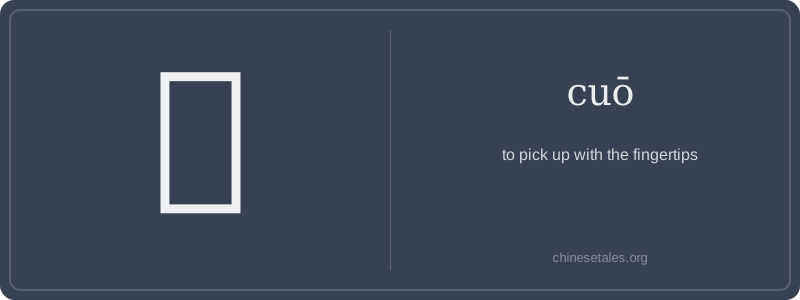
The earliest form of 撮 appears in seal script as a combination of 扌 (hand radical) and 最 (zuì, 'utmost'), but crucially, the 'most' part wasn’t about superlatives — it was phonetic, approximating the ancient pronunciation *tsʰat*. Visually, the modern character retains 扌 on the left (three strokes: horizontal, vertical, and hook — representing a hand in motion), while the right side, 最, evolved from a pictograph of a tree top (木) crowned by a marker (取), later stylized into its current 12-stroke complexity. The full 15-stroke structure thus fuses 'hand action' with a phonetic anchor — a classic phono-semantic compound.
By the Han dynasty, 撮 had solidified its core meaning of 'to gather with fingertips', appearing in texts like the *Shuōwén Jiězì* (c. 100 CE) as 'taking a small amount'. Its semantic range subtly expanded: in Tang poetry, it described birds gathering twigs (撮枝为巢); in Song medical texts, pharmacists were instructed to '撮药' — measuring herbs by fingertip pinch, where each 'pinch' equaled a precise dosage unit. The visual echo of 'topmost' (最) may even reinforce the idea of selecting the *very tip* or *finest portion* — not just any bit, but the choicest fragment, lifted with care.
At its heart, 撮 (cuō) captures a uniquely precise, almost intimate physical gesture: using just the thumb and two fingers — not a full grasp, not a pinch with nails, but a delicate, controlled lift. It’s the motion of plucking a single sesame seed from a bowl, lifting a tiny medicinal herb for inspection, or gathering a pinch of incense powder before scattering it in a temple. This isn’t brute force; it’s dexterity, intention, and respect for smallness — values deeply embedded in Chinese craft, medicine, and ritual.
Grammatically, 撮 is primarily a verb, often used in formal, literary, or technical contexts (e.g., traditional pharmacy or culinary arts), and rarely in everyday spoken Mandarin — which is why it’s absent from the HSK lists. It can take an object directly (撮起一点盐) or appear in compound verbs like 撮合 (to mediate a match). Learners mistakenly use it like 拿 (ná, 'to take') or 捏 (niē, 'to pinch'), but 撮 implies *minimal contact*, *fingertip precision*, and *a small quantity* — never a large or heavy object. Saying '我撮了书' sounds absurdly comical, like trying to lift a textbook with your fingertips alone.
Culturally, this character reveals how Chinese language granularly encodes embodied experience: there’s no English equivalent that carries the same tactile specificity. In classical texts, it appears in medical manuals describing herb preparation, and in Ming-Qing fiction when a courtesan '撮起香灰' — a quiet moment of reverence or calculation. Modern learners’ biggest trap? Overusing it after encountering it in a drama or recipe — remember: 撮 is the whisper of the hand, not its shout.