揿
Character Story & Explanation
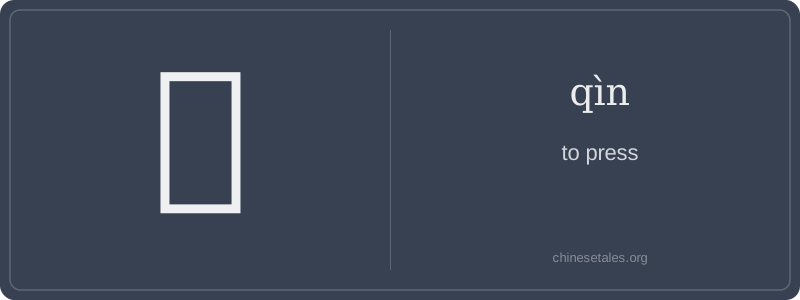
The earliest form of 揿 appears not in oracle bones, but in seal script (c. 3rd century BCE), where it combined 扌 (hand radical) with 欽 (qīn, originally meaning ‘to respect deeply’, but here serving phonetically). Visually, the right side 欽 was simplified over centuries: its top 钅 (metal radical) eroded into 金’s top stroke, while the bottom 欠 (‘to yawn’ — suggesting opening/movement) morphed into the current 亲 shape. By the Song dynasty, the character stabilized into its modern 12-stroke form: three strokes for 扌 (hand), then nine for 亲 — with the final dot (丶) added to distinguish it from similar characters and reinforce the ‘point-of-contact’ idea.
This evolution reflects semantic refinement: though 欽 meant reverence, its sound was borrowed to convey a specific kind of hand action — one requiring focus and precision, like bowing *to* something before pressing *it*. In classical texts, 揿 rarely appeared alone, but by the Ming-Qing period, it surfaced in technical manuals describing machinery and architecture, especially for ‘pressing a latch’ or ‘depressing a lever’. Its modern meaning crystallized in early 20th-century urban narratives — Lao She’s stories feature characters 揿电铃 (qìn diànlíng) outside hutong courtyards, capturing both technological novelty and social ritual: pressing the bell wasn’t just functional; it announced your presence with quiet authority.
Think of 揿 (qìn) as the Chinese equivalent of the satisfying *click* you hear when pressing a vintage elevator button or a mechanical doorbell — not just any press, but a deliberate, often tactile, downward action with intention and feedback. Unlike generic verbs like 按 (àn, 'to press') which covers everything from tapping a phone screen to pushing a piano key, 揿 carries a subtle weight: it implies pressing something solid, often protruding (a button, a switch, a bell), usually with the fingertip, and frequently with an audible or mechanical result. It’s the verb you’d use for ‘pressing the doorbell’ — not ‘pressing send’.
Grammatically, 揿 is a transitive verb that almost always takes a concrete, physical object — you 揿 a button (揿按钮), 揿铃 (qìn líng, press the bell), or 揿开关 (qìn kāiguān, flip/press the switch). You won’t say 揿电脑 (‘press the computer’) — that’s nonsensical. Learners often overgeneralize it like 按, leading to unnatural phrasing. Also, note its tone: qìn is fourth tone, sharp and decisive — mirroring the action itself. It rarely appears in compound verbs or aspect particles like 了 or 过 unless context demands precision (e.g., 他揿了一下门铃 — ‘He pressed the doorbell once’).
Culturally, 揿 evokes mid-20th-century urban life in China: the brass doorbell on a Shanghai lane house, the red emergency button in a factory control room, or the push-to-talk switch on an old radio. It’s slightly formal, even nostalgic — you’ll see it more in literature or technical manuals than in casual WeChat chats (where 按 dominates). A common mistake? Using 揿 for touchscreen taps — native speakers will instinctively correct you to 点 (diǎn) or 按. This character isn’t about light contact; it’s about *engagement* — a small, firm, consequential press.