擉
Character Story & Explanation
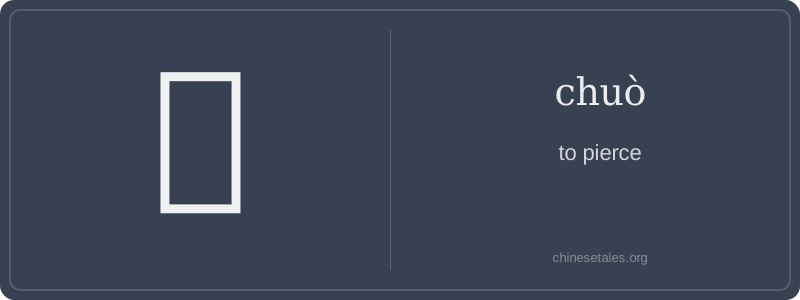
The earliest form of 擔 appears in bronze inscriptions as a hand (扌) holding a pointed tool — perhaps an awl or a double-pronged skewer — aimed downward at a horizontal line representing flesh or meat. Over time, the tool evolved into the complex ‘叕’ component: four stacked ‘又’ (yòu, ‘again’) glyphs, visually echoing repeated thrusting motions. The left-hand ‘hand’ radical remained constant, anchoring the action as intentional and manual. By the Han dynasty clerical script, the shape stabilized into today’s balanced but dense form — 16 strokes, compact and purposeful, like a clenched fist gripping a skewer.
This visual logic shaped its meaning: not generic ‘pierce’, but *controlled, repeated, purposeful penetration* — especially for preparation (e.g., skewering before roasting) or ritual (e.g., piercing sacrificial offerings). The Tang poet Du Fu used it in ‘擋羊炙’ (chuò yáng zhì) — ‘skewering and roasting lamb’ — highlighting both technique and reverence. Even today, the character’s density and repetition in ‘叕’ silently echo that rhythmic, methodical motion — a silent choreography written in ink.
Imagine a sharp, deliberate stab — not angry, not careless, but precise, almost surgical: that’s the visceral feel of 擔 (chuò). It’s not the casual ‘poke’ of 戳 (chuō), nor the violent ‘stab’ of 刺 (cì); 擔 carries literary weight and physical intentionality, like piercing thick leather with an awl or skewering meat on a stick. You’ll rarely hear it in daily speech — it’s a classical and literary character, preserved in poetry, historical texts, and culinary terms (think roasted lamb skewers).
Grammatically, 擔 functions as a transitive verb, always requiring a direct object: you 擔 something — never just ‘you 擔’. It’s often paired with objects like 肉 (meat), 羊 (lamb), or 魚 (fish), especially in cooking contexts. Learners sometimes misread it as chuō (like 戳) due to the similar sound and the ‘hand’ radical, but that’s a critical error — 擔 is never used for light poking or accidental contact. Also, don’t confuse its structure: the right side isn’t ‘卓’ (zhuó) — it’s ‘叕’ (zhuó), an ancient repetitive component hinting at repeated piercing motion.
Culturally, 擔 evokes craftsmanship and control — the butcher’s steady hand, the artisan’s precision. It appears in Tang dynasty poetry describing ritual offerings and Ming-Qing cookbooks detailing ‘skewered roasting’ (擋烤). Modern learners encounter it mostly in food writing or classical allusions — so if you see it on a menu for ‘spit-roasted mutton’, you’re not just ordering dinner; you’re stepping into a 1,200-year-old culinary gesture.