擩
Character Story & Explanation
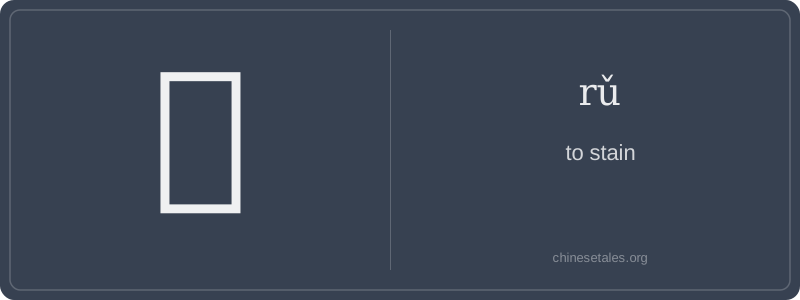
The earliest form of 擩 appears in Han dynasty bamboo slips and early clerical script, not oracle bones — it’s a relatively late semantic-phonetic compound. Its left side 扌 (hand radical) clearly signals manual action, while the right side 染 (rǎn, 'to dye') was borrowed *not for meaning, but for sound*: ancient pronunciations of 染 and 擩 were near-homophones. Over centuries, 染’s top part (水 + 九) simplified into 冄 — a stylized, cursive rendering that lost its water association but kept the phonetic anchor. By the Song dynasty, the modern shape solidified: three distinct strokes atop the hand radical, looking like a quick, downward press of fingers into liquid.
This visual evolution mirrors its semantic journey: from a generic 'dyeing' concept in early texts (e.g., in the *Shuōwén Jiězì*, it’s glossed as 'to soak in color'), 擩 narrowed to emphasize *the moment of contact* — not the result, but the *act of dipping*. Classical poets used it sparingly for vivid effect: Li Bai once wrote of '擩墨欲書' (rǔ mò yù shū, 'dipping ink to write'), highlighting the poised, intentional gesture before calligraphy. Even today, when a Cantonese elder says '擩下薑汁' (rǔ haa gēung jūk), they’re not just applying ginger juice — they’re performing a small, deliberate ritual of care.
At first glance, 擩 (rǔ) feels like a linguistic ghost — rare, almost theatrical, and deeply tactile. It doesn’t mean ‘to stain’ in the passive, accidental sense (like 傷 or 污), but rather *to deliberately dip and coat* — think of plunging fingers into ink, smearing grease on a hinge, or daubing medicine onto a wound. The action is intimate, physical, and often slightly messy: it’s always done *with the hand*, and nearly always implies contact that leaves a visible trace.
Grammatically, 擩 is a transitive verb that demands an object — you 擩 something *into* something else. It’s almost never used alone; you’ll see structures like 擩進 (rǔ jìn, 'dip into'), 擩上 (rǔ shàng, 'smear onto'), or 擩了…一下 (rǔ le… yí xià, 'dabbed briefly'). Unlike common verbs like 涂 (tú, 'to paint') or 沾 (zhān, 'to沾/brush against'), 擩 carries a rustic, visceral weight — it appears more in regional dialects, classical allusions, or literary descriptions of manual labor than in daily conversation.
Culturally, 擩 evokes pre-modern craftsmanship: inkstone rituals, herbal poultices, blacksmithing, or temple incense preparation. Learners often misread it as 染 (rǎn, 'to dye') due to the shared 'staining' idea — but that’s a critical error: 染 implies gradual, full absorption (like fabric in dye), while 擩 is abrupt, localized, and surface-level. Also, watch the tone: rǔ (third tone) is easily mispronounced as rū (first) or rù (fourth), which could accidentally summon words like 'ruin' or 'enter'!