摈
Character Story & Explanation
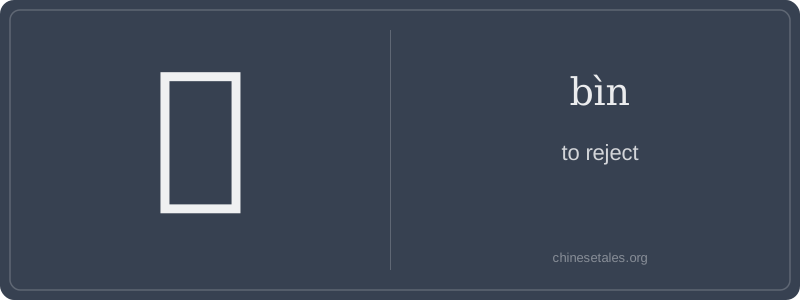
The earliest form of 摈 appears in seal script (c. 3rd century BCE), where the left side clearly shows 扌 (hand radical), and the right side resembles 宾 (bīn, 'guest'), but with subtle stroke variations. In bronze inscriptions, 宾 itself depicted a person kneeling respectfully before a ruler — a guest receiving ritual hospitality. When 扌 was added to 宾, the character visually encoded the paradoxical act of 'using the hand to handle the guest' — but not to welcome. Rather, it evolved to mean 'handling the guest so as to remove them': the hand pushes away the very figure once honored. The modern form preserves all 13 strokes faithfully: three horizontal strokes at the top of 宾 (representing ceremonial headdress), the vertical 'person' line, and the crucial sweeping捺 (nà) stroke that looks like a firm, outward shove.
This semantic shift — from 'honored guest' to 'expelled outsider' — reflects ancient Chinese political ritual: to publicly 'receive' someone was power; to publicly 'dismiss' them was even greater power. By the Han dynasty, 摈 appears in texts like the Hanshu describing scholars 'bìn yú zhèngtǒng' (rejected from orthodoxy) for heretical views. The character’s visual tension — hand + guest — never resolved into warmth, but hardened into authority: the hand doesn’t grasp, it ejects; the guest isn’t seated, they’re escorted out. Even today, the stroke order ends with that decisive捺 — like the final slam of a courtroom door.
Think of 摈 (bìn) as the Chinese equivalent of slamming a velvet rope across a VIP entrance — not just 'no,' but 'you are formally excluded from this space, hierarchy, or discourse.' Unlike generic synonyms like 拒绝 (jùjué, 'to refuse') or 排斥 (páichì, 'to exclude' with scientific or systemic overtones), 摈 carries deliberate, often institutional weight: it’s used when authorities, groups, or traditions actively cast someone out — politically, academically, or socially. You’ll see it in headlines like '政府摈弃旧政策' (The government rejects the old policy), where the tone implies principled dismissal, not mere disagreement.
Grammatically, 摈 is almost always transitive and formal — you *must* specify what or whom is being rejected. It rarely stands alone; instead, it appears in compound verbs like 摈弃 (bìnqì, 'to discard utterly') or in passive constructions like '被摈于主流之外' (excluded from the mainstream). Learners often mistakenly use it like an intransitive verb ('He was摈') — but no: 摈 demands an object, like a judge demanding evidence before sentencing.
Culturally, 摈 echoes Confucian notions of ritual propriety (礼 lǐ): to 摈 someone isn’t just personal dislike — it’s a calibrated act of social boundary-drawing, sometimes with moral gravity. A common error? Using it for casual rejection (e.g., 'I don’t like this coffee'). That’s way too mild — save 摈 for expelling ideologies, disavowing corrupt officials, or rejecting outdated dogma. Its rarity outside formal writing (hence its absence from HSK) signals seriousness — like pulling out a gavel instead of waving a hand.