擸
Character Story & Explanation
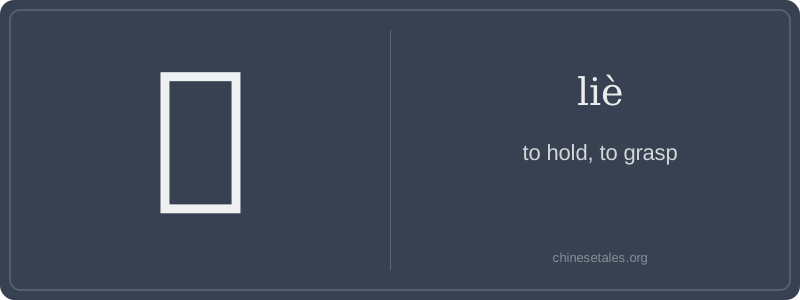
The earliest trace of 擸 appears not in oracle bones but in late Warring States bamboo slips and Han dynasty seals, where it emerges as a compound of 扌 (hand radical) and 列. 列 itself originally depicted a line of weapons or banners standing upright — think of soldiers in formation. So imagine the original form: a hand reaching *into* or *taking charge of* that ordered line — not just lifting one item, but asserting control over a set. Over centuries, the hand radical standardized into 扌, while 列 lost its pictorial clarity and became a phonetic-semantic hybrid: still hinting at 'ranked arrangement', now also guiding pronunciation (liè).
By the Tang dynasty, 擸 was entrenched in military and ritual texts as the verb for ceremonial grasping — like a high official 擸圭 (liè guī), gripping the jade tablet signifying rank. In Ming-Qing fiction, it gained dramatic flair: heroes 擸刀劈空 ('seized the saber and slashed the air'), turning gesture into narrative punctuation. Its visual logic remains elegant: the hand (扌) doesn’t hover — it *engages* the structure (列), transforming passive presence into active possession. That fusion of physical action and hierarchical intent is why this character never faded into obscurity — it’s too precise, too vivid, to replace.
Let’s cut through the fog: 擸 (liè) is a rare, literary character meaning 'to hold firmly with the hand' — not just casual holding like 拿 (ná), but gripping, clutching, or seizing with intent and physical tension. Think of gripping a sword hilt before battle, or snatching a falling scroll mid-air. It carries weight, urgency, and agency — you don’t 擸 your coffee cup; you 擸 your destiny. Its tone (fourth tone) mirrors that sharp, decisive snap.
Grammatically, 擸 is almost always transitive and appears in classical or literary contexts — rarely in spoken Mandarin or modern textbooks. It typically takes a concrete, graspable object (a weapon, a banner, reins, a sleeve) and often pairs with verbs of motion or intention: 擸劍而起 (liè jiàn ér qǐ — 'grasped the sword and rose'). Learners mistakenly try to substitute it for common verbs like 拿 or 握, but that’s like using 'clutch' instead of 'hold' in every sentence — technically possible, but instantly marks you as quoting ancient poetry, not ordering baozi.
Culturally, 擸 evokes martial resolve and classical heroism — it’s the verb of choice in historical novels when a general seizes command or a scholar grabs a brush to write a defiant poem. Modern learners rarely need it conversationally, but spotting it in texts like Records of the Grand Historian or Jin Yong’s wuxia novels signals deep reading fluency. A classic trap? Confusing its right-hand component 扌 (hand radical) with the similar-looking 又 (yòu, 'again') — but here, 扌 is unmistakably the hand, and the left side 列 (liè) isn’t just phonetic: it implies 'arranged ranks', suggesting controlled, deliberate action — not random grabbing.