摅
Character Story & Explanation
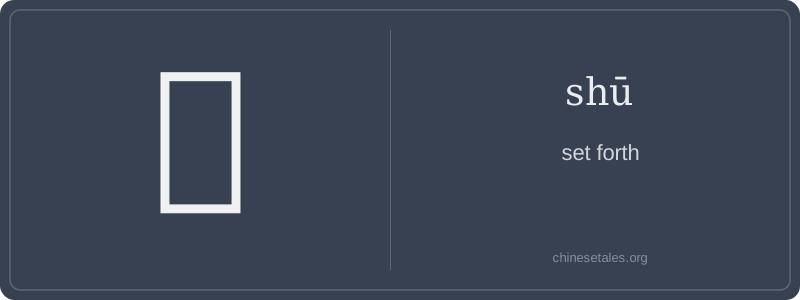
The earliest form of 摅 appears in bronze inscriptions as a composite glyph: on the left, 扌 (a hand radical), and on the right, a simplified depiction of a *spool of thread being unwound* — not unlike the ancient character for 俞 (yú), which itself evokes smooth passage. Over centuries, the right side evolved through seal script into 舒, which originally meant 'to stretch out' or 'to uncoil', reinforcing the idea of gradual, controlled release. By the Han dynasty, the modern shape stabilized: 13 strokes, with the hand radical anchoring action and the phonetic-semantic component 舒 guiding both pronunciation (shū) and meaning (unfolding, expanding).
This visual logic — hand + uncoiling — became semantic truth: 摅 was used in the *Zuo Zhuan* and Han fu poetry to describe scholars 'drawing forth' moral principles from ancient texts or 'unfurling' their innermost sentiments in elegies. The Tang poet Li Bai wrote of 摅怀寄月 ('drawing forth his feelings to entrust them to the moon'), transforming inner turmoil into lyrical release. Even today, the character’s structure whispers its history: every stroke is a coil being gently loosened — not dumped, not shouted, but deliberately, artfully, *set forth*.
At its heart, 摅 (shū) isn’t just ‘to set forth’ — it’s the deliberate, almost ceremonial act of drawing something *out* from within: thoughts from the mind, emotions from the heart, or arguments from deep reflection. Unlike generic verbs like 表达 (biǎo dá, 'to express'), 摅 carries classical weight and literary elegance — you’d use it in a formal essay, a poetic preface, or a scholar’s critique, never in texting your friend about lunch. It implies effort, intention, and intellectual generosity: not just saying something, but *unfurling* it with care.
Grammatically, 摅 is almost always transitive and appears in compound verbs or literary phrases — you rarely see it alone. It pairs naturally with abstract nouns: 摅发 (shū fā, 'to bring forth'), 摅写 (shū xiě, 'to set down in writing'), or 摅怀 (shū huái, 'to give vent to one’s feelings'). Learners often mistakenly treat it like a casual synonym for 说 (shuō) or 讲 (jiǎng), which sounds jarringly archaic — imagine saying 'I shū my opinion' instead of 'I state my opinion'. That mismatch breaks register instantly.
Culturally, 摅 reveals how deeply Chinese rhetoric values *source and substance*: to 摅 is to reach into reservoirs of cultivated thought, not to react impulsively. Classical texts like the *Wen Xin Diao Long* (The Literary Mind and the Carving of Dragons) praise writers who 摅情敷藻 ('draw forth feeling and spread ornate language') — underscoring that true expression begins inward, then expands outward with discipline. Mistake it for a simple verb, and you’ll sound like someone quoting Confucius at a coffee shop — noble, but wildly out of place.