撄
Character Story & Explanation
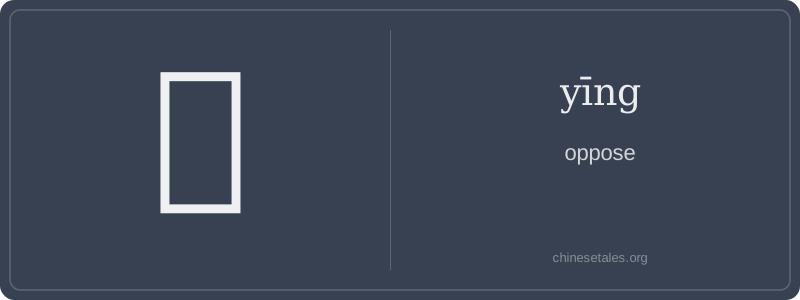
The earliest form of 撄 appears in Warring States bamboo slips as a hand (扌) reaching toward a complex element resembling two interlocked ‘strings’ or ‘bindings’ (the top part of today’s 羅-like structure, later simplified to 婴). That upper component wasn’t decorative — it depicted *entangled threads*, symbolizing something knotted, resistant, or ensnaring. The hand wasn’t pushing *away*, but *engaging*, *grasping*, even *tangling* with that resistance — hence the core sense of ‘brushing against, provoking, confronting’. Over centuries, the entangled threads morphed into 婴 (yīng, originally ‘infant’ but here purely phonetic), while 扌 stayed anchored on the left, solidifying the modern 14-stroke shape.
This visual logic endured: 撄 never meant blunt opposition — it meant *entering the fray*, making contact with what opposes you. In the Zuo Zhuan, we read of ministers who 撄君之威 (yīng jūn zhī wēi) — ‘tangle with the ruler’s awe’ — not by rebelling openly, but by persistently advising against reckless war, thereby testing the limits of authority. The character’s shape literally shows a hand reaching *into* complexity, not slamming a door shut. Even today, its usage preserves that ancient precision: you don’t 撄 a policy — you 撄 its underlying injustice.
At its core, 撄 (yīng) isn’t just ‘oppose’ — it’s the visceral act of *provoking resistance*: brushing against, tangling with, or daring to challenge something powerful, often at personal risk. Think less 'I disagree' and more 'I deliberately confront the tiger’s tail.' It carries weight, tension, and classical gravity — you won’t hear it in casual chats or HSK dialogues; it lives in essays, historical analysis, and literary critique. Its feel is sharp, almost tactile: like fingertips grazing a thorned vine.
Grammatically, 撄 is almost always transitive and formal, appearing in compound verbs (e.g., 撄怒, 撄锋) or as the verb in tightly packed classical-style phrases. It rarely stands alone — you won’t say *‘wǒ yīng tā’*; instead, you’ll see *‘yīng qǐ tā de nùhuǒ’* (provoke his fury) or *‘bù kě yīng’* (must not provoke). Learners often misapply it as a general synonym for 反对 (fǎnduì), but that’s like using ‘assail’ instead of ‘disagree’ — tone and register are wildly mismatched.
Culturally, 撄 echoes Confucian restraint: to 撄 is to cross an invisible line — of authority, decorum, or cosmic order. Classical texts use it to describe ministers who dare question tyrants, or scholars who challenge orthodoxy. A common mistake? Confusing it with 婴 (yīng, ‘infant’) due to identical pronunciation — but mixing them up turns ‘he provoked disaster’ into ‘he infant-disaster’, which is… poetically alarming. Use it only when stakes are high, language is elevated, and nuance matters.