撺
Character Story & Explanation
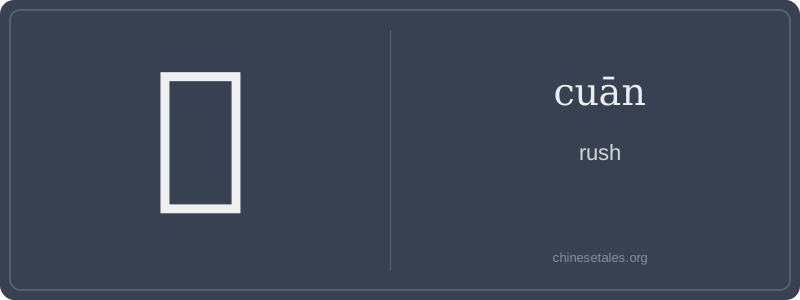
Oracle bone and bronze inscriptions show no direct precursor for 撺 — it’s a later creation, likely emerging in the Warring States or Han period as a phono-semantic compound. Its left side 扌 (hand radical) signals action involving the hands or body. The right side, 鬯 (chàng), is key: originally a pictograph of a ritual wine vessel with aromatic herbs steaming upward — symbolizing rising vapor, sacred energy, and *unstoppable ascent*. Over centuries, 鬯 simplified into the modern 撺’s top-heavy, jagged right component (⺈ + 丶 + 冖 + 曰), preserving that sense of surging, upward force.
This visual logic shaped its meaning: from ritual steam rising → energy surging → body leaping → speech inciting. In Ming-Qing vernacular novels like Water Margin, 撺 appears in martial scenes ('he 撺上房梁' — 'he vaulted onto the roof beam'), and by the Qing era, its figurative use exploded — especially in 撺掇 (cuānduo), meaning 'to egg on', capturing how words can propel action like steam propels a piston. The character’s very strokes mimic a body coiling then exploding upward: the three dots (丶丶丶) are like spring-loaded feet, the horizontal stroke (一) is the push-off, and the final 'mouth' (曰) hints at shouted encouragement — all embedded in its 15 strokes.
At its core, 撺 (cuān) isn’t just ‘rush’ — it’s a vivid, almost kinetic verb that captures *sudden, upward-directed, often impulsive motion*: think leaping, darting, surging, or even inciting someone to act rashly. It’s not neutral like 跑 (pǎo, 'to run') — it carries urgency, verticality, and sometimes mischief. You’ll rarely see it alone; it thrives in compound verbs like 撺上去 (cuān shàng qù, 'to dash up'), 撺下台 (cuān xià tái, 'to be rushed off stage'), or the idiom 撺火点 (cuān huǒ diǎn, 'to fan the flames').
Grammatically, 撺 is almost always transitive and requires direction: 上, 下, 进, 出, or through prepositional phrases. Saying *'他撺了' is incomplete — it demands where or what was rushed. Learners often wrongly treat it like an intransitive verb or confuse its tone (cuān, not cuàn or cuǎn), leading to mispronunciation that sounds like 'cuan' (a slangy homophone for nonsense). Also, it’s almost never used for calm, planned movement — no one 撺 to a meeting at 9 a.m. sharp.
Culturally, 撺 pulses with theatrical energy: it’s deeply rooted in traditional opera (where actors literally *leap* onto stage) and folk storytelling (where elders say 撺掇 — a related form — to describe sly encouragement). Modern usage leans colloquial and slightly negative: 撺掇 someone usually implies manipulative urging. A classic learner trap? Writing it as 撩 (liāo, 'to flirt') or 搅 (jiǎo, 'to stir') — both share 扌 but lack the explosive 'upward thrust' encoded in 撺’s right side.