攧
Character Story & Explanation
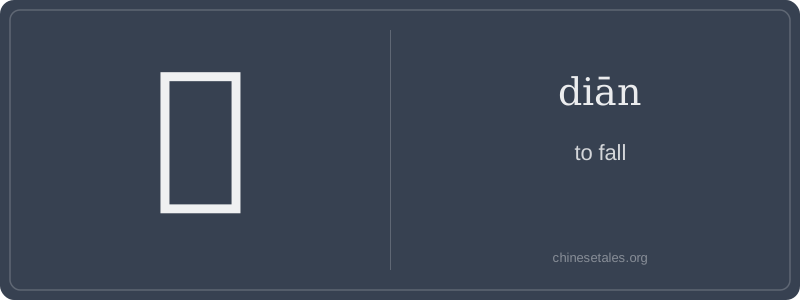
The earliest form of 攧 appears in late Warring States bamboo slips, not oracle bones — and it’s a masterclass in motion-as-writing. The left side, 足 (zú, ‘foot’), was originally a detailed pictograph of a bent leg stepping off-balance; the right side, 颠 (diān), wasn’t borrowed randomly — its top part (‘top of head’) + bottom (‘rock’) visually echoed the idea of ‘head-over-heels’. Over centuries, the foot radical simplified from a full limb to 趍, and the ‘rock’ component eroded into the squiggle you see today — yet the sense of destabilized locomotion remained intact.
By the Tang dynasty, 攧 had crystallized as a verb for involuntary, rotational falling — appearing in Dunhuang ballad texts describing acrobats ‘diān rù huǒ zhōng’ (tumbling into fire) and in Song-dynasty medical manuscripts warning against ‘diān shāng jǐng’ (neck injury from tumbling backward). Its literary weight grew precisely because it avoided the clinical tone of 倒 (dǎo) and the poetic abstraction of 仆 (pū); instead, 攧 kept feet, gravity, and surprise firmly on the page — a rare character that makes physics feel personal.
Think of 攧 (diān) as Chinese’s ‘tumbleweed moment’ — not the gentle sway of a Western frontier cliché, but a sudden, uncontrolled, often comical collapse: knees buckling, teacup flying, dignity vanishing mid-step. Unlike the neutral ‘fall’ of 掉 (diào) or the tragic ‘fall’ of 陨 (yǔn), 攧 carries kinetic chaos — it’s what happens when you step on a banana peel *in classical prose*. It’s almost exclusively literary or dialectal (especially in northern and Sichuan speech), rarely used in modern standard Mandarin outside idioms or vivid storytelling.
Grammatically, 攧 is almost always transitive and action-focused: you 攧 someone (‘jolt them down’), or 攧 yourself (‘pitch forward’). You won’t say ‘I fell’ as *wǒ diān le* — that would sound archaic or theatrical. Instead, it appears in constructions like *bèi rén diān le yī gè gū lǔ* (was jolted into a somersault) or *diān zài dì shàng* (tumbled onto the ground). Notice the physicality: it implies rotation, loss of balance, and abrupt downward motion — never just vertical descent.
Culturally, learners often misread 攧 as a variant of 颠 (diān, ‘to shake’ or ‘upside-down’), since they share pronunciation and visual similarity. But that’s a classic trap: 颠 evokes mental instability or political upheaval (e.g., 颠覆 *diānfù*, ‘to overthrow’), while 攧 is purely bodily and visceral. Also, don’t confuse it with 蹦 (bèng, ‘to bounce’) — 攧 has no rebound; it’s all downward momentum, no spring. Its rarity in textbooks means encountering it feels like spotting a literary fossil — thrilling, but demanding context clues.