攲
Character Story & Explanation
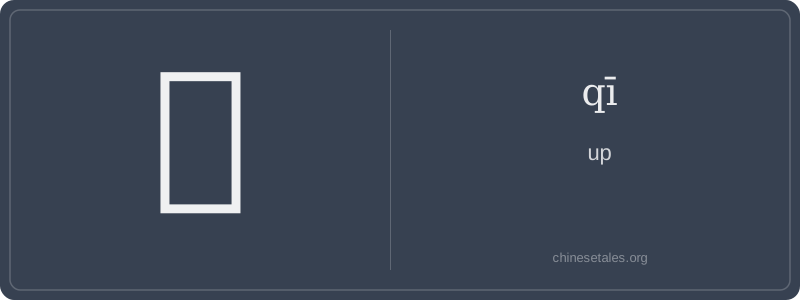
The earliest form of 攲 appears in Warring States bamboo slips as a vivid pictograph: a hand (又 yòu radical) gripping the corner of a rectangular object — perhaps a raised platform or an elevated tray — while the top line slopes upward sharply, visually shouting 'lifted here!'. Over centuries, the hand morphed into the left-side component 乞 (qǐ, originally 'beg', but here purely phonetic), while the right side evolved from a simple slanted platform into the elegant, three-stroke 木 (mù, 'wood') — symbolizing a crafted, stable base *intentionally tilted*. By the Han dynasty, the structure stabilized into today’s form: 乞 + 木, with the slant preserved in the final stroke’s upward thrust.
This visual logic became semantic truth: in the Shuōwén Jiězì (121 CE), Xu Shen defined 攲 as 'the state of wood raised at one end' — referencing carpenters’ leveling tools and scholars’ writing desks angled to avoid glare. In Tang poetry, Du Fu used 攲 in describing a crane’s neck 'tilted toward heaven' — not bent, but *elevated with purpose*. The character never meant 'up' abstractly; it always implied *asymmetric elevation*: one edge lifted, the other grounded — a perfect metaphor for classical Chinese ideals of harmony through contrast.
Let’s be honest: you won’t find 攲 on any modern menu, subway sign, or WeChat chat — and that’s precisely what makes it fascinating. Its core meaning isn’t just 'up' in the literal sense (like 上 shàng), but rather a poetic, almost architectural 'tilted upward' — suggesting imbalance with intention, like a scholar’s inkstone angled to catch light or a scholar’s sleeve lifting as he gestures emphatically during debate. It evokes elegance in asymmetry, a very Chinese aesthetic value rooted in Daoist and literati traditions where perfection lies not in rigidity but in dynamic equilibrium.
Grammatically, 攲 is almost never used alone today; it appears exclusively in classical compounds or literary set phrases, always as a descriptive modifier — never as a verb or standalone noun. You’ll see it in phrases like 攲斜 (qī xié, 'tilted upward'), where it modifies the direction of slant, adding nuance that shàng or xié alone can’t convey. Learners often misread it as a variant of 奇 (qí, 'strange') or assume it's interchangeable with 歪 (wāi, 'crooked'), but those carry connotations of disorder or defect — while 攲 carries quiet dignity, even reverence.
Culturally, 攲 reveals how deeply Chinese thought embeds motion and perspective into static forms: this character doesn’t just name a position — it implies the *act* of lifting one edge, the conscious choice to elevate part of a whole. Mistake it for 倚 (yǐ, 'to lean on')? You’ll accidentally suggest dependence instead of poised ascent. It’s a ghost of classical Chinese still haunting poetry, calligraphy rubbings, and antique catalogues — not dead, just waiting for the right context to rise again.