敁
Character Story & Explanation
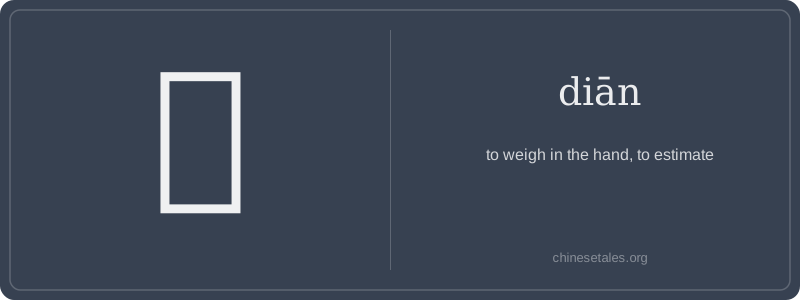
The earliest trace of 敁 appears not in oracle bones, but in Han dynasty clerical script (lìshū), where its left side — the hand radical 扌 — was already clear, and the right side resembled a simplified version of 占 (zhān), meaning 'to divine' or 'to occupy'. But here’s the twist: that right component wasn’t 占 — it was actually a stylized depiction of two hands lifting a small object, later miswritten as 占 through centuries of cursive simplification. The original form visually shouted 'hands weighing', not 'hand divining'.
By the Tang and Song dynasties, 敁 had settled into its modern shape and meaning: 'to weigh by hand'. Classical texts like the *Dream of the Red Chamber* use it to convey subtle social assessment — e.g., a maid 敁ing a gift to gauge the giver’s status or sincerity. Its visual logic remains beautifully literal: 扌 (hand) + 占 (here, phonetic reinforcement for diān, *not* semantic 'divination') = the act of lifting and judging via palm sensation. No metaphor needed — just anatomy and intention fused in ink.
Think of 敁 (diān) as the Chinese equivalent of 'hefting' — that little up-and-down hand motion you make when judging how heavy a melon or suitcase is, all without scales. It’s not about precise measurement; it’s intuitive, tactile estimation: feeling weight, density, or even abstract 'heaviness' like responsibility or emotional gravity. The character evokes quiet physicality — no shouting, no instruments, just palms and instinct.
Grammatically, 敁 is almost always a verb, used transitively (it needs an object), and often appears in literary or descriptive contexts rather than casual speech. You’ll rarely hear it in daily conversation, but you’ll see it in novels describing characters sizing up a mysterious package (他敁了敁那布包) or a merchant testing silk for quality (她敁了敁料子的厚薄). Note: it’s never used with units (no 'grams' or 'jin'), and never passive — you can’t say 'the bag was 敁’d'; only someone actively 敁s something.
Culturally, 敁 carries a subtle air of discernment and quiet authority — the kind of judgment reserved for elders, artisans, or connoisseurs. Learners often misread it as diǎn (to point/arrange) due to similar pronunciation, or overextend it into modern slang ('I’m 敁-ing this job offer!'). But 敁 resists abstraction: it stays stubbornly physical, rooted in touch. Its rarity outside classical and literary registers means encountering it feels like unearthing a linguistic artifact — respectful, precise, and faintly archaic.