敕
Character Story & Explanation
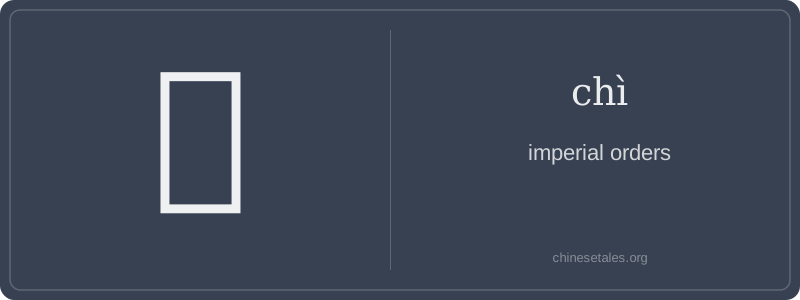
The earliest form of 敕 appears on Western Zhou bronze inscriptions as a compound pictograph: at left, a simplified representation of 'speech' or 'words' (later evolving into the radical 口 or 彳), and at right, a hand holding a rod or whip (the precursor to 攵). This wasn’t about punishment — it was about *enactment*: words made effective by sovereign power, literally 'spoken command + enforcing action.' Over centuries, the left side stabilized into the 'beneath heaven' component ( + 冖 + 朿), while the right became the standard 'strike/act' radical 攵 — eleven strokes total, each reinforcing the idea of authoritative speech that compels reality to change.
By the Han dynasty, 敕 had crystallized as the exclusive term for edicts issued by the emperor himself — distinct from 诏 (zhào), which could be broader imperial proclamations. In the Tang legal code, 敕 carried binding force equal to law; in the Ming novel Journey to the West, the Jade Emperor issues a 敕 to summon celestial generals — showing how its meaning expanded to divine decrees too. Visually, the top part (冖朿) resembles a stylized 'heavenly canopy' over 'thorns' (symbolizing unyielding authority), while 攵 anchors it in human execution — a perfect visual metaphor: heaven’s will, enacted by the emperor’s hand.
Think of 敕 (chì) as the linguistic equivalent of a sealed imperial edict — not just 'an order,' but one stamped with ultimate authority, issued directly from the emperor’s vermilion brush. It carries weight, solemnity, and divine mandate; it’s never casual or bureaucratic. You’ll almost never hear it in spoken Mandarin today — it lives in classical texts, historical dramas, and formal inscriptions. Its core feeling is 'command-as-destiny': when the emperor 敕, heaven and earth align to obey.
Grammatically, 敕 functions primarily as a verb meaning 'to issue an imperial decree' — always transitive and always elevated. You won’t say 'I 敕 you to do X'; instead, it’s 'the Emperor 敕 the general to advance' (皇帝敕將軍進軍). It can also appear as a noun: 敕命 (chìmìng) means 'imperial commission' — not just a job title, but a sacred trust granted by the Son of Heaven. Learners sometimes misread it as 'to scold' (confusing it with 責 or 斥), but 敕 contains zero anger — only unassailable, ritualized authority.
Culturally, 敕 evokes the entire Confucian cosmology: the emperor mediates between heaven and humanity, so his 敕 isn’t mere policy — it’s cosmic alignment made verbal. A common mistake? Using it in modern administrative contexts ('The CEO 敕ed the team'). That’s like calling a Zoom meeting 'a royal audience.' Reserve 敕 for emperors, deities, or deliberate archaic flair — otherwise, use 命令 (mìnglìng) or 指示 (zhǐshì). Its rarity makes it potent: one 敕 in a sentence instantly transports your reader to the Forbidden City at dawn.