敫
Character Story & Explanation
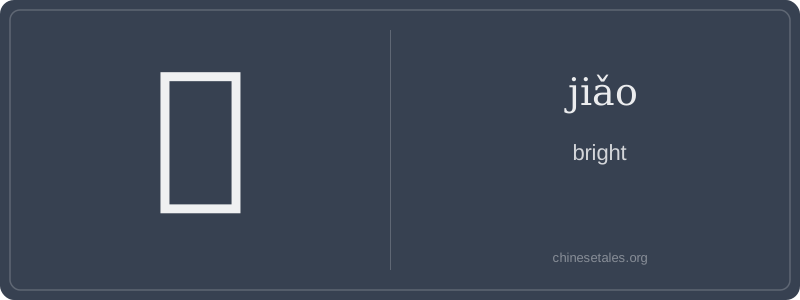
The earliest form of 敫 appears in late Warring States bamboo slips and Han dynasty seals — not as a pictograph, but as a phono-semantic compound already well-formed. Its left side, 朮 (shù, an archaic variant of 术, ‘art/method’), was originally a stylized representation of growing grain stalks, symbolizing cultivation and refinement; its right side, 攵 (pū, ‘to tap’ or ‘to correct’), evolved from a hand holding a rod — implying deliberate action, discipline, and polish. Over centuries, 朮 simplified into the top-heavy structure we see today, and 攵 standardized into its familiar three-stroke ‘walking’ radical shape — transforming the whole character into a visual metaphor: ‘brightness achieved through cultivated discipline.’
This etymology shaped its semantic journey: in the Classic of Poetry (Shījīng), 敫 first described the clear, unclouded light of dawn over ritual altars — not physical illumination, but the luminosity of sacred correctness. By the Tang dynasty, poets like Li Bai used 敫然 to depict sudden enlightenment — a flash of insight that feels both pure and earned. Even today, when a scholar writes 敫洁, they’re invoking not just cleanliness, but the moral luster of integrity polished over time — a brightness inseparable from virtue and effort.
Think of 敫 (jiǎo) as the 'glow-in-the-dark' character — not flashy like 火 (fire) or radiant like 明 (bright), but quietly luminous, almost ethereal. It carries a classical, poetic weight: you won’t hear it in daily chats or order food with it, but you’ll find it shimmering in ancient poetry, calligraphy inscriptions, or formal literary descriptions — like a candle’s steady flame in a quiet hall. Its brightness is serene, intelligent, and dignified, never blinding or loud.
Grammatically, 敫 functions almost exclusively as an adjective, and it *never* stands alone. You’ll always see it paired — most commonly in compound words like 敫洁 (jiǎo jié, ‘pure and bright’) or 敫然 (jiǎo rán, ‘clearly evident; lucid’). Unlike common adjectives such as 好 or 大, it doesn’t take degree adverbs (no *very* 敫 or *so* 敫); instead, it relies on classical syntactic frames — often followed by 然, 亮, or 洁 to complete its meaning. Trying to say ‘This room is 敫’ would sound jarringly unnatural — native speakers would instinctively reach for 明亮 or 光亮.
Culturally, 敫 evokes Confucian ideals of inner clarity and moral radiance — think of a sage whose virtue shines without effort. Learners often misread it as 熬 (to boil) or 激 (to excite) due to visual similarity, or mistakenly assume it’s interchangeable with 明. But here’s the trap: while 明 is daylight clarity, 敫 is moonlight clarity — subtle, reflective, and deeply textual. It appears mainly in written registers, so hearing it spoken aloud is rare — which makes listening practice nearly impossible. Your best bet? Read Tang poetry and Song essays slowly, pencil in hand.