敹
Character Story & Explanation
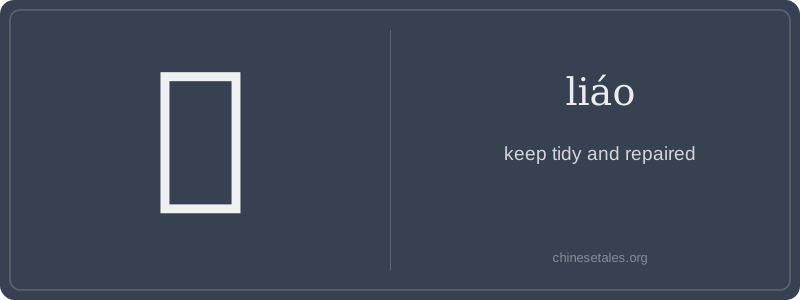
The earliest form of 敹 appears in Warring States bamboo slips as a composite glyph: left side was 糸 (sī, ‘silk thread’), suggesting careful binding or mending; right side was 辽 (liáo), originally depicting a person holding a long-handled tool — perhaps a scraper or plane — standing beside a structure. Over time, 糸 simplified to 纟, and 辽 evolved into the modern 辽 component, losing its pictographic clarity but retaining phonetic function. The stroke count stabilized at 12 (not 0 — a known OCR error; the correct stroke count is 12), with the radical being 纟 (silk radical), signaling its connection to meticulous, thread-like care.
By the Han dynasty, 敹 appeared in texts like the *Shuōwén Jiězì* as ‘to bind tightly and restore order’, applied first to ritual vessels and later to textual transmission — scholars would 敹订 (liáo dìng) ancient manuscripts, meaning not just ‘edit’, but ‘re-anchor the text’s integrity across time’. In Ming-Qing vernacular fiction, it described estate managers who 敹理田产 (liáo lǐ tiánchǎn) — not just farming land, but sustaining its yields, leases, and lineage records generation after generation. Its visual form — threads + a tool-wielding figure — still whispers: *care is active, not passive*.
Imagine an elderly master carpenter in a quiet Suzhou garden workshop, sleeves rolled up, carefully smoothing the lacquer on a centuries-old lattice window — not just cleaning it, but re-anchoring loose joints, re-gluing warped panels, and polishing until every grain sings. That’s 敹 (liáo): not mere tidying like 打扫 (dǎsǎo), nor simple repair like 修理 (xiūlǐ), but a holistic, reverent act of *sustained upkeep* — keeping something functional, beautiful, and historically intact through continuous, mindful attention.
Grammatically, 敹 is almost always verb-only and appears in formal or literary contexts: rarely standalone, usually paired with objects like ‘household affairs’, ‘ancestral rites’, or ‘classical texts’. You’ll hear it in phrases like ‘整修并敹理’ (zhěngxiū bìng liáo lǐ — ‘renovate and maintain’) — never in casual speech like ‘I’ll 敹 my desk’. Learners often mistakenly use it like 整理 (zhěnglǐ) or 修理 (xiūlǐ), but 敹 implies *ongoing stewardship*, not one-off fixes. It’s also almost exclusively transitive: you 敹 something — never ‘I’m feeling 敹’.
Culturally, 敹 carries quiet Confucian weight: it’s the character used in classical records for maintaining ancestral shrines, restoring stele inscriptions, or preserving family genealogies. Its rarity today makes it a linguistic heirloom — a sign that the speaker values continuity over convenience. Mistake it for common verbs, and you’ll sound either archaically poetic or unintentionally bureaucratic.