斛
Character Story & Explanation
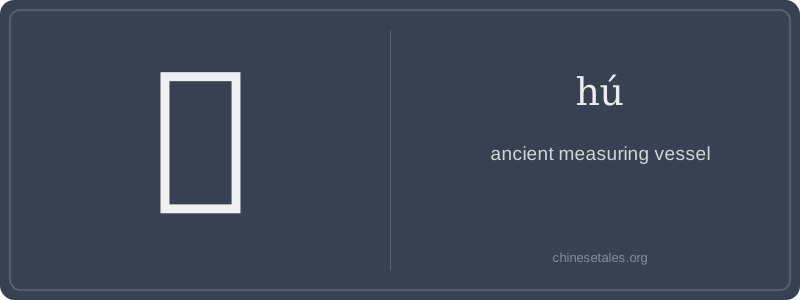
The earliest form of 斛 appears on Warring States bamboo slips as a combination of 斗 (a pictograph of a ladle with handle and bowl) and 角 (jiǎo, originally depicting a horn cup). The original bronze script showed 斗 on the left and 角 on the right — not as separate characters, but fused: the ‘horn’ shape evolved into the top-right component (⺈ + 丶 + 丿), while the 斗 radical anchored the bottom-left. Over centuries, the angular horn softened into the flowing strokes we see today — the 11 strokes encode both function (pouring) and form (vessel).
By the Han dynasty, 斛 was standardized at 10 dou (about 20 liters), replacing earlier regional variations. It appears in the *Book of Han* describing granary inspections and in Du Fu’s poetry lamenting famine — where ‘five 斛 of millet’ wasn’t just volume, but survival. Intriguingly, its visual structure mirrors its purpose: the 斗 radical implies action (scooping), while the upper part suggests containment (like a horn-shaped mouth), making 斛 a rare character that *looks* like it’s holding something — which it did, for millennia.
At its heart, 斛 (hú) isn’t just a dusty unit — it’s a quiet monument to China’s obsession with precision in ritual, agriculture, and statecraft. In classical texts, 斛 measured grain for tax collection, tribute, and famine relief; its very existence reflects how deeply measurement was tied to moral order — a ruler who misused the 斛 risked cosmic imbalance. Modern learners rarely use it actively, but encountering it in historical novels or museum labels instantly evokes imperial bureaucracy and agrarian life.
Grammatically, 斛 functions strictly as a measure word — like ‘gallon’ or ‘bushel’ — always following a numeral or quantifier: 一斛米 (yī hú mǐ, 'one hú of rice'). It never stands alone as a noun without context, nor does it take possessives or modifiers directly. Learners often mistakenly treat it like a regular noun ('the 斛 is old') — but in Chinese, you’d say 这个斛 (zhège hú) only when pointing to a physical vessel; otherwise, it’s always bound to quantity + noun.
Culturally, 斛 reveals how Chinese conceptualizes scale: not abstractly, but through tangible, human-sized objects — the 斗 radical literally means 'ladle', grounding measurement in daily labor. A common mistake is confusing 斛 with modern metric units (e.g., saying 斛 instead of 升), but it’s obsolete outside historical or literary contexts. Its survival in compounds like 石斛 shows semantic drift — from measuring grain to naming an orchid whose tuber resembles a tiny 斛-shaped root.