斡
Character Story & Explanation
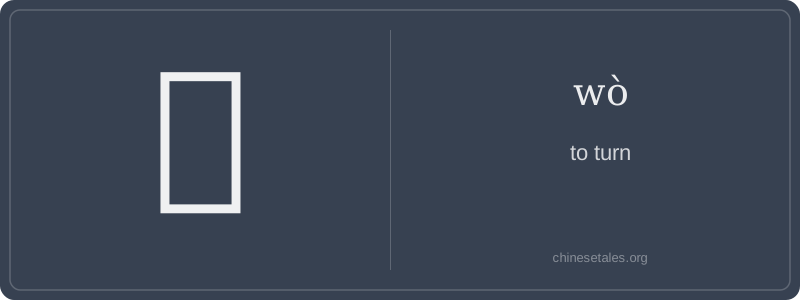
The earliest form of 斡 appears in Warring States bamboo slips and small-seal script — not as a pictograph of a physical object, but as a dynamic ideograph: the left side (‘wò’ phonetic component, later simplified to 翁 minus the ‘flesh’ radical) suggested pronunciation, while the right side was 斗 — a bronze ladle or dipper used for scooping and *rotating* grain or wine. Imagine an official using a ceremonial 斗 to lift, tilt, and pour liquid — each motion a deliberate pivot. Over centuries, the phonetic element evolved from 翁 to 敖 to its current form, and the 斗 radical remained anchored on the right, visually grounding the idea of controlled, vessel-assisted turning.
This image of ritualized rotation shaped its semantic evolution: in the Zuo Zhuan, 斡 described how ministers ‘turned’ state affairs toward stability; in Tang poetry, it depicted celestial forces ‘turning’ the seasons. By the Ming dynasty, it became entrenched in diplomatic language — especially 斡旋 (wò xuán), literally ‘turning the pivot,’ meaning mediation: two parties locked in tension, and a third party gently rotating their positions until alignment emerges. The character’s enduring power lies in this fusion of tool (斗), motion (turning), and agency (the hand behind the ladle).
Think of 斡 (wò) as the Chinese equivalent of a masterful stagehand — not the star, but the unseen force that pivots the plot, shifts the spotlight, and rotates the set. Its core meaning 'to turn' isn’t about spinning in place like a top; it’s about *purposeful, consequential turning*: redirecting policy, reversing fate, or steering diplomacy. It carries weight, intention, and often high stakes — you won’t use it to describe stirring tea or turning a page.
Grammatically, 斡 is almost never used alone. It appears only in classical or literary compounds (like 斡旋 or 斡运), always as part of a disyllabic verb. Learners who try to say 'wò zhè gè' ('turn this') will sound jarringly archaic — like quoting Shakespeare at a coffee shop. It resists modern colloquial grammar: no aspect particles (了, 过), no reduplication, no bare verb usage. If you see it, it’s likely in formal writing, historical novels, or political commentary — often paired with abstract nouns: fate, affairs, power, time.
Culturally, 斡 evokes the quiet authority of the minister who ‘turns’ imperial decrees into action — not by force, but by deft reorientation. A common mistake? Assuming it’s interchangeable with 转 (zhuǎn). But while 转 is neutral and ubiquitous (turning corners, changing jobs), 斡 implies strategic influence over complex systems. Misusing it can unintentionally inflate your sentence into grandiose, even bureaucratic, territory — imagine saying 'I 斡 my career path' instead of 'I changed my career path.'