於
Character Story & Explanation
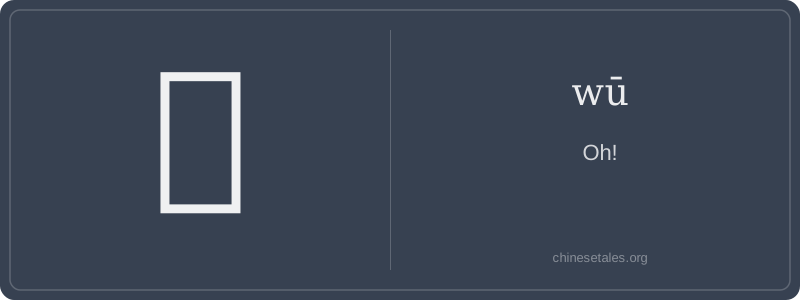
The earliest form of 於 appears in late Warring States bamboo slips and Han dynasty seals — not as a pictograph of a thing, but as a stylized *sound-symbol compound*. Its left side 方 (fāng, ‘square, region’) was borrowed for its pronunciation (ancient *qʰaŋ* → *u*), while the right side 亍 (chù, ‘to step slowly’) provided phonetic reinforcement and visual rhythm. Over centuries, 亍 simplified into the elegant, balanced hook-and-dot flourish we see today — eight strokes arranged with ceremonial symmetry: three horizontal lines (stability), a vertical anchor (authority), and a final rising dot (the spark of realization).
This character wasn’t born from observation — it was *composed*, like a musical notation for vocal emphasis. In the Classic of Poetry (Shījīng), 於 appears 27 times, always introducing lines of revelation: ‘於嗟乎!’ (‘Ah, alas!’), ‘於皇武王!’ (‘Oh, glorious King Wu!’). Its shape mirrors its function: the square radical grounds the emotion; the flowing right side lifts the voice upward — literally and graphically. Even today, calligraphers pause before writing 於, knowing they’re inscribing not just a word, but a moment of shared human awe.
At first glance, 於 (wū) looks like a formal, almost archaic exclamation — and it is! Unlike the cheerful, colloquial ‘ā!’ or ‘yā!’, 於 carries the weight of classical Chinese poetry and ritual speech: it’s the gasp before a revelation, the pause before wisdom drops. Think of it as the ancient Chinese equivalent of ‘Lo!’ or ‘Behold!’ — not just surprise, but awe-infused recognition. It’s rarely used in daily speech today, but appears with quiet power in literary quotations, opera lyrics, and ceremonial proclamations.
Grammatically, 於 functions as an interjection — always standing alone or at the start of a sentence, never modifying nouns or verbs. It never takes particles like 啊 or 呀, and never appears in compound words as a functional element (unlike 于, its homophone but unrelated character). You’ll hear it in lines like ‘於!此乃天意也’ — where the 於 isn’t translated as ‘oh’ but *felt* as a breath-held moment before destiny unfolds. Learners often misread it as the preposition 于 (yú), leading to hilarious mistranslations — imagine reading ‘於此’ as ‘Oh! here!’ instead of the correct ‘at/upon this’.
Culturally, 於 reveals how Chinese aesthetics values resonance over repetition: one well-placed interjection can carry more emotional gravity than five exclamations. Its rarity makes it precious — like finding a single antique seal in a modern office. Mistake it for 于? You’ll sound like someone quoting Confucius… while ordering takeout. Use it intentionally, sparingly, and with reverence — and you’ll instantly signal literary fluency.