旃
Character Story & Explanation
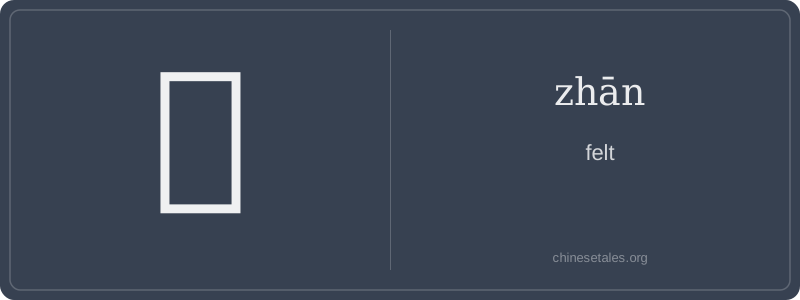
The earliest form of 旃 appears in Warring States bamboo slips — not oracle bone, but close: it combines 方 (a square-shaped frame, representing loom or boundary) with 丹 (dān, 'cinnabar red'), originally written with a dot inside a 'well' shape (冂+一+丶). The 丹 component wasn’t about color alone — cinnabar was prized for dyeing fine wool, and its presence signaled treated, high-grade felt. Over time, the inner strokes of 丹 simplified into two horizontal lines and a dot, merging with 方’s right vertical stroke to form today’s 10-stroke structure: 方 + 丹 → 旃.
By the Han dynasty, 旃 appeared in texts like the Book of Han describing Xiongnu banners — '旃旌' (zhān jīng), meaning 'felt banners' that stood upright without wind, symbolizing unyielding authority. Later, poets like Li Bai used 旃 metaphorically: '云旃' (yún zhān, 'cloud-felt') evoked banners drifting like wool clouds across mountains. Its visual logic remains striking: 方 anchors the character in human-made order; 丹 whispers of ritual dye and value — together, they turn humble wool into sovereign textile.
At first glance, 旃 (zhān) feels like a quiet relic — it means 'felt' (the thick, non-woven textile), but you’ll almost never hear it in daily speech. Unlike modern words like 毛毡 (máo zhān), which use the more common character 毡, 旃 is archaic, poetic, and deeply embedded in classical aesthetics. It carries a tactile elegance: think of nomadic banners flapping on northern steppes or ceremonial robes lined with soft, dense wool — not just material, but status, warmth, and resilience against harsh skies.
Grammatically, 旃 functions mainly as a noun, often in literary or historical contexts — never as a verb or adjective. Crucially, it appears in fixed classical constructions like '之...旃', an archaic pronoun + particle structure (e.g., ‘其乐也融融,其喜也旃旃’ — rare but attested), where 旃 serves as a sentence-final particle meaning 'indeed' or 'truly'. Learners rarely encounter this usage, but confusing it with modern particles like 焉 or 焉 will derail comprehension — 旃 here is purely phonetic, borrowed for sound, not meaning.
Culturally, 旃 reveals how Chinese writing preserves texture and tactility through abstraction: its radical 方 (fāng, 'square/region') hints at woven, structured fabric — not randomness, but intentional density. Mistake it for 毡 (also 'felt'), and you’ll miss centuries of textual nuance: 毡 is practical and modern; 旃 is lyrical, imperial, and faintly incense-scented from ancient court records. It’s the difference between buying felt at IKEA and unrolling a Tang-dynasty banner in a museum vault.