旴
Character Story & Explanation
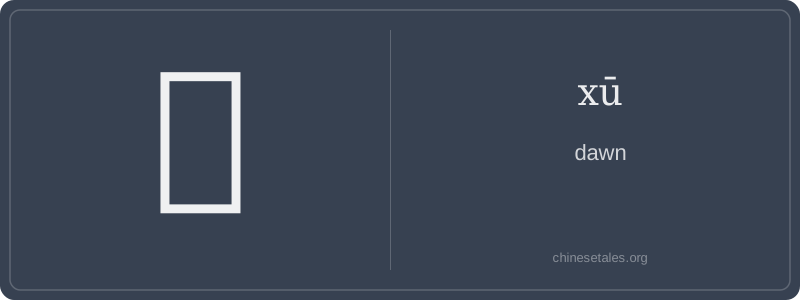
The earliest form of 旴 isn’t found in oracle bones — it’s a later creation, likely from the Warring States or Han period, designed as a semantic-phonetic compound. Visually, it’s elegant austerity: the left side is the ‘sun’ radical 日 (rì), unmistakable even in seal script; the right side is 匚 (fāng), a container-like enclosure, but here acting phonetically for xū (closely related to 呴, an ancient word for gentle exhalation — like breath mingling with first light). Over centuries, the 匚 simplified into its current boxy shape, while 日 stayed pristine — a sun literally held in the palm of the east.
This character was born from landscape and observation: the people of the ancient Yú region (modern Jiangxi) named their river 旴江 because its course bends eastward, catching dawn light earlier than surrounding rivers. In the 12th-century anthology Yunlüe, 旴 is glossed as 'the sun rising in the east', and in Ming dynasty poetry, it appears in lines like '旴光破雾' — 'dawn-light pierces the mist'. Its visual stillness (no dynamic strokes like 飞 or 升) mirrors its meaning: not the act of rising, but the serene, luminous *presence* of dawn itself — a moment suspended, not rushed.
旴 (xū) is a poetic, almost ghostly character — it doesn’t just mean 'dawn'; it evokes the first fragile light spilling over eastern hills, that hushed, silver-blue moment before birdsong begins. It’s not a word you’d use in daily chat ('zǎo shang' is far more common), but one that breathes life into classical poetry, place names, and literary metaphors for renewal or revelation. Its feel is quiet, luminous, and deeply directional: always tied to the east (hence the ‘日’ sun radical on the right) and the idea of light emerging *from* darkness.
Grammatically, 旴 rarely stands alone. You won’t say '旴了' like '亮了' (it got bright). Instead, it appears in fixed compounds (like 旴江 or 旴曙) or as part of proper nouns — especially place names in Jiangxi province (e.g., 旴江 Xū Jiāng, a river named for its eastern-facing banks where dawn breaks first). Learners sometimes try to force it into modern verbs or adjectives — a classic trap! Remember: this character is a noun or a modifier in formal, lyrical contexts, never colloquial speech.
Culturally, 旴 carries the weight of ancient cosmology: in Chinese thought, the east is the direction of birth, wood, spring, and the rising sun — all embodied in this character. Its rarity today makes it a subtle marker of literary sophistication. A common mistake? Confusing it with 昜 (yáng, an archaic variant of 陽) or even 易 (yì) — both visually similar but semantically worlds apart. Misreading 旴 as 易 in a classical text could turn 'dawn’s first gleam' into 'change' — a beautiful but catastrophic misinterpretation!