昀
Character Story & Explanation
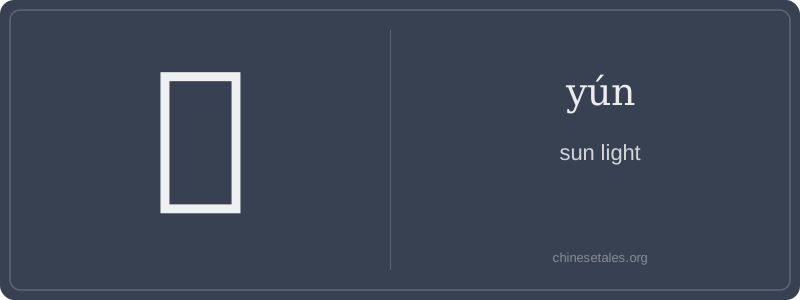
The character 昀 first appeared in seal script during the Warring States period, evolving from the radical 日 (rì, 'sun') on the left — originally a circular sun with a dot at center — fused with 均 (jūn, 'even, balanced') on the right. 均 itself combines 匀 (yún, 'to distribute evenly') and 土 (tǔ, 'earth'), suggesting harmonious distribution. So visually, 昀 was conceived as 'the sun’s light distributed evenly across the earth' — not raw solar power, but its gentle, equitable diffusion.
This idea of balanced, serene light became central to its semantic development. By the Han dynasty, 昀 appeared in astronomical texts describing the sun’s benevolent illumination, distinct from the harsh glare of 炎 (yán, 'flame') or the abstract brightness of 明 (míng, 'bright'). It’s notably absent from the Shuōwén Jiězì (121 CE), appearing later in annotated commentaries and poetry anthologies — a late-blooming character that matured precisely because Chinese aesthetics valued restraint over intensity. Its form, with the sun radical anchoring the left and the flowing, symmetrical strokes of 均 on the right, mirrors its meaning: light that doesn’t shout, but settles — like gold dust suspended in still air.
昀 (yún) is a poetic, literary word for 'sunlight' — not the blazing noon sun, but the soft, luminous quality of light itself: gentle, clear, and radiant. Think of dawn mist catching golden rays or sunlight filtering through gauzy curtains. It’s not a daily-conversation word like 日 (rì, 'sun') or 光 (guāng, 'light'), but one you’ll find in classical poetry, names, and refined prose — evoking elegance and quiet brilliance.
Grammatically, 昀 functions almost exclusively as a noun, rarely as a verb or adjective. You won’t say 'the sky is 昀' — instead, it appears in compound nouns (e.g., 昀光 yún guāng, 'sunlight') or as part of personal names (especially female given names, where it conveys grace and brightness). A common learner mistake is trying to use it alone like 光 — but 昀 *never* stands solo in modern usage; it’s always paired or embedded. Its tone (yún, second tone) also trips up beginners who misread it as yùn (like 运), so listen carefully: it rhymes with 'moon', not 'tune'.
Culturally, 昀 carries a subtle Daoist-Buddhist resonance — light as clarity of mind, not just physical illumination. In Tang poetry, it’s rare, but by the Ming-Qing period, it gained favor in scholarly circles for its understated luminosity. Don’t force it into casual speech — but when you see it in a name like 李昀 (Lǐ Yún) or in a phrase like 昀和 (yún hé, 'gentle radiance'), pause and savor its quiet weight.