昉
Character Story & Explanation
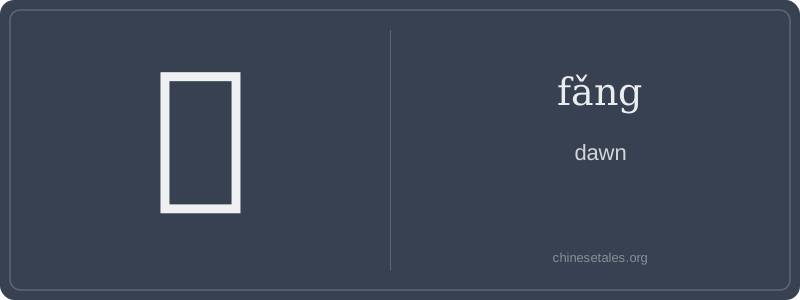
The earliest form of 昉 appears in Han dynasty seal script — not oracle bone, as it’s a later creation — built from 日 (rì, 'sun') on the left and 方 (fāng, 'direction', 'square', 'method') on the right. Visually, it’s a sun rising squarely into a new direction: the sun (日) anchored beside the structured, upright shape of 方 (which itself evolved from a pictograph of a boat or a ritual vessel, later abstracted into 'squareness' and 'order'). Its eight strokes are clean and balanced: four for 日 (top horizontal, left vertical, bottom horizontal, right vertical), then four for 方 (dot, horizontal, turning stroke, final hook-like捺).
This composition isn’t accidental — it embodies the ancient cosmological idea that dawn is not just light returning, but cosmic order reasserting itself after night’s chaos. In classical texts like the *Wen Xuan* (Selections of Refined Literature), 昉 appears in parallel couplets praising the emperor’s virtue as 'bright as the fǎng', linking celestial regularity with moral clarity. The character’s visual symmetry mirrors its semantic weight: the sun doesn’t burst forth wildly — it rises deliberately, methodically, 'in the direction of light'. That precision is why 昉 still graces scholar’s studio names and newborns’ names today: it promises not just new day, but new purpose.
昉 is a poetic, literary word for 'dawn' — not the everyday sunrise you’d use in weather reports or casual chat, but the hushed, luminous moment when night first yields to light: delicate, hopeful, and deeply atmospheric. It evokes the quiet awe of early morning before birdsong swells, carrying a classical elegance that modern Mandarin rarely permits. You’ll almost never hear it in speech; it lives in poetry, names (especially given names), and formal prose — like a brushstroke of ink on rice paper rather than a neon sign.
Grammatically, 昉 functions as a noun or time noun, often paired with time markers like 在 or 于, and rarely stands alone. It doesn’t take aspect particles (no 昉了 or 昉过) and resists colloquial modifiers — saying *很昉 or *昉一下 sounds jarringly wrong, like calling a haiku 'very short'. Instead, it appears in set phrases: 昉明 (fǎng míng, 'dawn brightness'), or in compound nouns like 昉曙 (fǎng shǔ, 'first light'). Its rarity means learners sometimes overuse it trying to sound 'literary' — a classic trap that makes native speakers blink politely.
Culturally, 昉 reflects how Chinese aesthetics prize subtlety and transition over spectacle: not the blazing sun, but the precise instant darkness begins to lift. It’s tied to renewal, scholarly aspiration ('at dawn one studies'), and gentle beginnings — think of Confucius’s 'At dawn, hear the Way; at dusk, die content'. Mistaking it for common words like 早 or 晨 is understandable, but loses this layered resonance: those mean 'early' or 'morning'; 昉 is specifically the *threshold* of light — the first breath of day.