昕
Character Story & Explanation
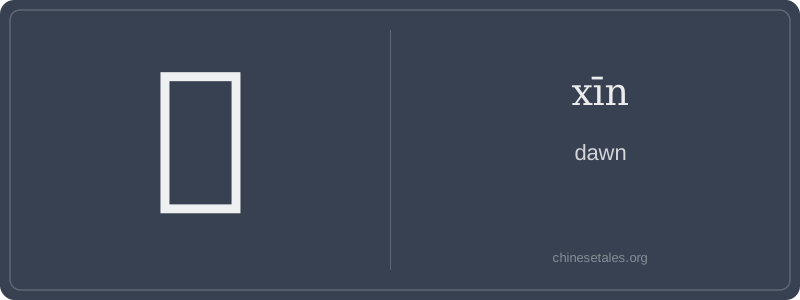
The earliest form of 昕 appears in seal script (c. 3rd century BCE), combining 日 (sun, radical) on the left with 斤 (a type of axe, later stylized) on the right. But don’t be fooled — 斤 here isn’t about chopping! In ancient phonetic loan usage, 斤 served purely as a sound hint (jīn → xīn via historical sound shifts), while 日 anchored the meaning. Over centuries, the 斤 component softened into today’s simplified right side — three horizontal strokes and a downward hook — losing its axe-like sharpness but keeping its phonetic role. Visually, it’s a sun rising *just enough* to cast its first gentle glow: no blaze, no glare — just luminous emergence.
This delicate balance shaped its meaning from the start. In the Shuōwén Jiězì (121 CE), China’s first dictionary, 昕 is defined as ‘the light of the rising sun’ — not the sun itself, but its earliest, most tender radiance. Classical poets like Li Bai and Du Fu rarely used it, reserving it for moments of serene transition: a hermit stepping out at daybreak, or a scholar gazing eastward before dawn’s full arrival. Its visual duality — sun + soft sound-sign — mirrors its semantic duality: concrete (light) and atmospheric (mood).
昕 isn’t just ‘dawn’ — it’s dawn as a poetic, almost sacred threshold: the first breath of light before sunrise, when darkness softens but the sun hasn’t yet crested the horizon. In Chinese sensibility, this moment carries quiet reverence — not the bustle of morning, but the hush of potential. It’s deeply literary and rarely used in speech; you won’t hear it in casual chat or weather reports (use 早晨 or 黎明 instead). Think of it as the ‘haiku word’ for dawn: elegant, restrained, and emotionally charged.
Grammatically, 昕 functions almost exclusively as a noun or in compound words — never alone as a verb or adjective. You’ll find it in names (especially given names like 李昕), poetry, formal writing, or titles (e.g., 昕光 ‘dawn light’ in a book title). Learners sometimes try to use it like a standalone subject in sentences like *‘昕 is beautiful’ — but that sounds archaic or unnatural. Instead, it appears embedded: ‘在昕光中’ (in the light of dawn), ‘迎昕’ (to welcome the dawn), always leaning on context or pairing.
Culturally, 昕 reflects how classical Chinese values precision of mood over literal time. While 黎明 marks sunrise and 拂晓 implies the first visible light, 昕 evokes the *anticipation* — the cool, silver stillness just before color returns to the world. A common mistake is overusing it thinking it’s a neutral synonym for ‘morning’. It’s not — it’s lyrical, slightly solemn, and quietly majestic. Use it like a calligrapher uses gold ink: sparingly, with intention.