昪
Character Story & Explanation
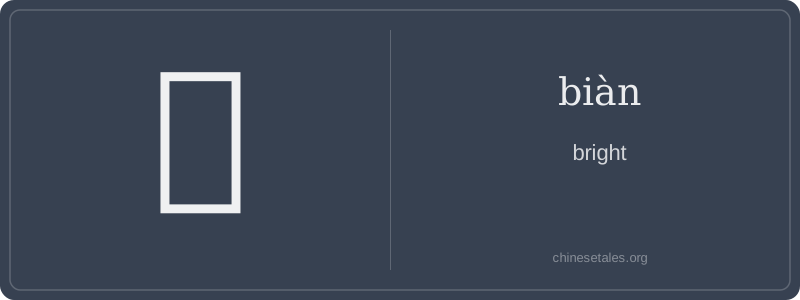
The earliest form of 昪 appears in bronze inscriptions from the late Western Zhou period (c. 9th century BCE) as a stylized sun (日) placed directly above a simplified depiction of a human figure kneeling with arms outstretched — not in worship, but in receptivity. Over centuries, the lower element evolved: the kneeling posture softened into the component 丿一乚 (a curved stroke suggesting open palms catching light), while the sun remained pristine and central. By the Han dynasty clerical script, the shape stabilized into today’s form: 日 atop a graceful, flowing base that looks like a gentle wave or unfurling silk — embodying light received, not emitted.
This origin explains why 昪 never meant ‘shining brightly’ like 熾 (chì) or 燦 (càn). Classical texts use it for moments of quiet epiphany: in the *Zhuangzi*, it describes the sage’s mind ‘明而昒’ — luminous yet unobtrusive; in Tang poet Wang Wei’s landscape verses, 昪 appears in ‘山色昒然’ (mountain hues glowing softly at dusk), where light isn’t dominant — it’s harmonious, participatory. The character’s visual grace mirrors its semantic restraint: it doesn’t shout ‘light’ — it breathes it.
Imagine standing at dawn on the Yellow River’s banks as mist lifts — not with a sudden burst, but with a slow, radiant unfolding: light seeping into reeds, gilding water, warming stone. That gentle, luminous emergence is exactly what 昪 (biàn) captures: not blinding glare or electric brightness, but a soft, pervasive, almost sentient radiance — like sunlight breathing into a quiet room. It’s poetic, intimate, and deeply atmospheric: think ‘luminous’, ‘glowing’, or ‘sun-warmed’ rather than just ‘bright’.
Grammatically, 昪 is rare in modern spoken Mandarin — you won’t hear it in daily conversation or see it on subway signs. It appears almost exclusively in literary compounds (like 昪昽 or 昪然), often as a descriptive modifier before nouns or in adverbial phrases. It never stands alone as a verb or adjective in contemporary usage — trying to say *‘this room is 昪’* would sound archaic or jarringly poetic to native ears. Instead, it thrives in fixed expressions where its quiet glow adds texture: 昪昽 (bì lóng) means ‘dimly luminous’, evoking twilight haze; 昪然 (bì rán) means ‘suddenly illuminated’ — not by a switch, but by insight or revelation.
Culturally, 昪 carries classical elegance — it’s a character you’ll find in Tang poetry, Song essays, and Ming drama, always hinting at inner clarity or natural harmony. Learners often misread it as biàn (like 辨 or 辩) due to identical pinyin, but that’s a trap: those characters mean ‘to distinguish’ or ‘to debate’, carrying intellectual tension, while 昪 is pure sensory serenity. Also, don’t confuse its radical (日) with the similar-looking 日 in everyday words like 日子 (rì zi, ‘day’) — here, the sun isn’t temporal; it’s luminous essence.