晅
Character Story & Explanation
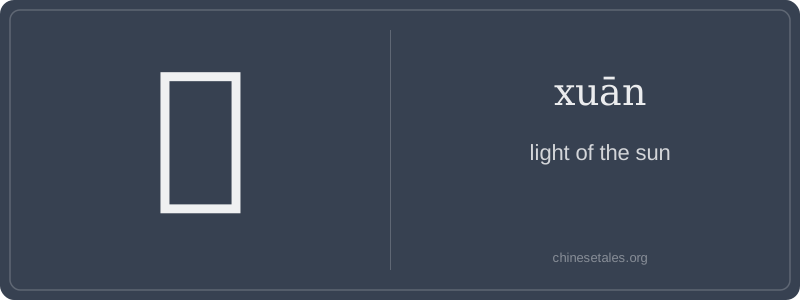
The character 晅 first appeared in late Han dynasty clerical script and was formalized in early regular script — it has no surviving oracle bone or bronze inscription form, because it’s a relatively late semantic-phonetic compound (not pictographic). Its left radical 日 (rì, 'sun') is unmistakable, while the right component 宣 (xuān) serves both phonetic and semantic roles: 宣 originally meant 'to proclaim publicly' (as in 宣布), evoking something visible, widespread, and authoritative — much like sunlight spreading openly across the land. Visually, the ten strokes flow gracefully: the sun ‘rises’ on the left, and the ‘proclamation’ unfolds to the right with balanced, open strokes — no sharp angles, all curves and horizontals suggesting diffusion and calm expansion.
By the Tang and Song dynasties, 晅 became a favorite in poetic diction for describing serene, auspicious daylight — especially in contexts of scholarly retreat or Daoist harmony with nature. The poet Wang Wei subtly used its semantic field in lines praising 'mountain light' (山晅), though he often wrote 宣 in variant forms. Its visual symmetry — sun + proclamation — reinforces its core idea: sunlight as nature’s gentle, universal announcement of presence, warmth, and renewal. This dual-layered origin (sound + meaning fused in one component) makes it a masterclass in how later Chinese characters encode philosophy in stroke order.
At its heart, 晅 (xuān) is a poetic, literary character meaning 'the light of the sun' — not just sunlight in general, but specifically its gentle, radiant, life-giving luminance. Think of dawn’s first golden wash over misty mountains or the soft glow on a scholar’s bamboo scroll at midday: it’s warm, dignified, and deeply aesthetic. Unlike common words like 阳光 (yángguāng) or 日光 (rìguāng), 晅 rarely appears in speech or modern prose; it lives almost exclusively in classical poetry, calligraphy inscriptions, and names — especially given names for girls (e.g., 李晅然) where it evokes brightness, purity, and quiet brilliance.
Grammatically, 晅 functions almost always as a noun or a descriptive noun-modifier, never as a verb or standalone adjective. You won’t say 'the sky is 晅' — that’s ungrammatical. Instead, it appears in tightly bound compounds (like 晅明 or 晅朗) or as part of elegant four-character phrases. Learners sometimes mistakenly treat it like 明 (míng, 'bright') and try to use it predicatively ('她很晅'), but this is as jarring to native ears as saying 'She is sunlight' in English — poetic in intent, ungrammatical in structure.
Culturally, 晅 carries a quiet Confucian elegance: it’s associated with clarity of mind, moral radiance, and cultivated grace — not flashy brilliance, but steady, benevolent illumination. A common learner pitfall is overusing it in writing, hoping to sound 'more Chinese', only to produce stilted, archaic-sounding text. It’s the kind of character you admire from afar — like a Ming dynasty porcelain vase: exquisite, meaningful, and best appreciated in its proper context.