晙
Character Story & Explanation
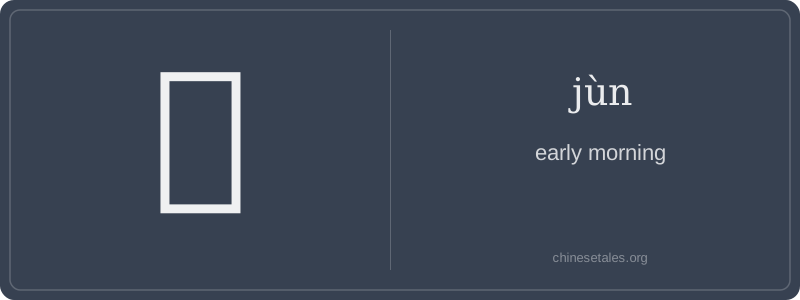
The earliest form of 晗 appears in Han dynasty clerical script, not oracle bones — and its structure is brilliantly literal. It combines 日 (rì, 'sun') on the left with 廴 (yǐn, a variant of 廴 meaning 'to advance slowly' or 'to extend') on the right. Wait — no! That’s a common misconception. Actually, the right side is 廴 + 亠 + 口 — evolving from an ancient pictograph depicting the sun rising *just above* the horizon line (represented by the horizontal stroke 一), with the mouth-like 口 suggesting the first breath of day or the opening sky. Over centuries, the top dot (丶) solidified, the horizon became the horizontal stroke, and the 'mouth' simplified into 口, yielding today’s elegant 12-stroke form.
This visual logic anchored its meaning: not sunrise as spectacle, but sunrise as subtle emergence — the precise instant the sun *begins* to show, not when it blazes. In the Classic of Poetry and Tang dynasty verse, 晗 appears in phrases like 晗色未分 ('dawn-color not yet distinct'), capturing that ambiguous, mist-softened threshold. Even today, calligraphers emphasize the delicate balance between the bold 日 and the slender, ascending right side — mirroring how dawn itself balances light and shadow, clarity and mystery.
Think of 晗 as Chinese poetry’s equivalent of the 'golden hour' in photography — not just 'early morning,' but that hushed, luminous, liminal moment when night hasn’t quite surrendered and day hasn’t fully claimed the sky. It carries a literary hush, a quiet reverence; you won’t hear it on subway announcements or weather apps. It’s the word poets reach for when describing dew-laced willows at dawn or Confucius walking alone before sunrise — evoking stillness, potential, and gentle illumination.
Grammatically, 晗 is almost always used as a noun or in compound nouns (like 晗光 or 晗色), rarely as a verb or standalone predicate. You’d say 晗光微露 ('the light of early dawn faintly appears'), not *晗已经来了. Learners often mistakenly treat it like a time adverb (e.g., *我晗去跑步) — but it doesn’t function like 早上 or 清晨. It’s more like 'dawnlight' than 'at dawn': a noun of atmosphere, not a clock.
Culturally, 晗 appears frequently in classical allusions and modern literary prose — especially in names (e.g., the poet Xu Zhimo’s pen name included 晗), calligraphy inscriptions, or poetic titles. Its rarity outside high-register contexts means learners who overuse it risk sounding unintentionally archaic or flowery. And yes — it’s pronounced jùn, not hán: the 'j-' sound (like 'jee') is a classic trap, since the character looks deceptively similar to 寒 (hán, 'cold').