晞
Character Story & Explanation
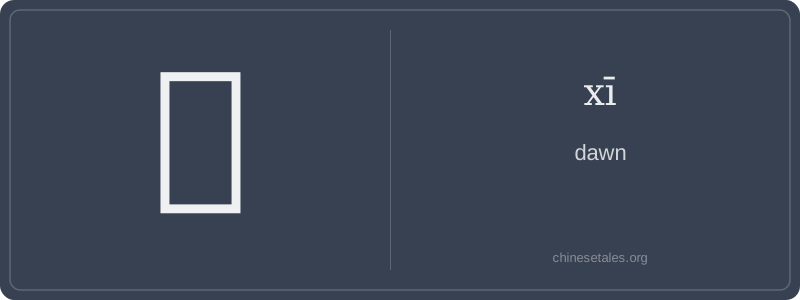
The earliest form of 晞 appears in Warring States bamboo slips as a compound ideograph: left side was 日 (rì, ‘sun’), right side was 希 (xī, ‘rare, faint’) — not as sound clue alone, but as semantic reinforcement: ‘the sun’s first appearance — rare, fleeting, barely there’. Over centuries, the right side simplified from 希’s full 7-stroke form (巾+爻) to today’s streamlined 7-stroke 希, preserving the visual whisper of scarcity and subtlety. Crucially, no ancient version depicted a person or action — only light’s quiet arrival.
This character didn’t emerge from practical timekeeping, but from lyrical observation. It appears in the Chu Ci (Songs of Chu, c. 3rd century BCE): ‘与汝沐兮咸池,晞汝发兮阳之阿’ — ‘Let us bathe in the Heavenly Pool; let dawn dry your hair on the sunlit slope.’ Here, 晞 is both verb (‘to dry in dawn light’) and noun (‘the drying light itself’) — a fluid duality lost in modern usage. Its shape — sun + rarity — mirrors its essence: the most precious light is the one you can’t hold, only witness.
晞 (xī) isn’t just ‘dawn’ — it’s the *first light that rinses away night*, carrying a poetic, almost sacred hush. In classical Chinese, it evokes not the clock-bound 6:03 a.m. of modern life, but the luminous, transient moment when dew glistens and shadows shrink — a time of quiet renewal deeply cherished in Daoist and early literary thought. You’ll rarely hear it in casual speech; it lives in poetry, names, and solemn prose, where its softness conveys reverence for beginnings and fragility.
Grammatically, 晞 functions almost exclusively as a noun or literary subject/object — never as a verb or modifier. You won’t say ‘I dawned’ (✘ 晞了) or ‘dawn light’ (✘ 晞光 — use 曦光 instead). Instead, it appears in elegant noun phrases like 晨晞 (chén xī, ‘morning dawn’) or as the sole subject: ‘晞在山脊上浮起’ (Dawn rises above the ridge). Learners often mistakenly treat it like 日 (rì, ‘sun’) or 早 (zǎo, ‘early’) — but 晞 is uncountable, untouchable, and always atmospheric.
Culturally, 晞 reveals how Chinese aesthetics values *ephemeral luminosity* over raw brightness: it’s the gentle, diffused glow before full sunrise — the kind that makes mist glow silver and bamboo leaves tremble with clarity. Mistaking it for stronger light words (like 曦 or 阳) strips away its delicate, lyrical weight. And yes — it’s absent from HSK because it’s too beautiful for exams: real language, not textbook language.