晪
Character Story & Explanation
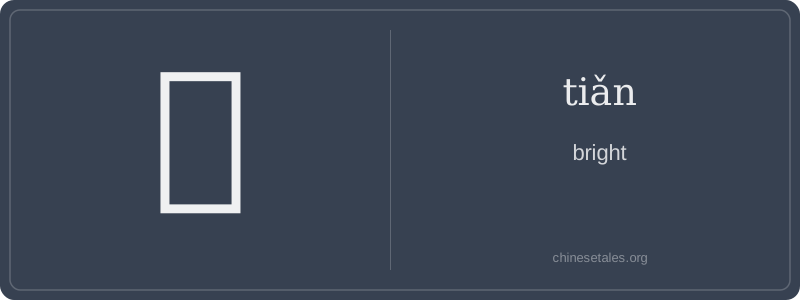
The earliest trace of 晪 appears not in oracle bones but in early clerical script (lìshū) from the Han dynasty, evolving from a combination of 日 (rì, 'sun') on the left and 典 (diǎn, 'ceremonial text, canon') on the right. The 日 radical was always clear — a square sun symbol — but 典 originally depicted hands holding open a sacred bamboo book. Over centuries, 典 simplified: its upper 'cover' strokes flattened, the central 'pages' condensed into two horizontal lines, and the lower 'hands' merged into a single curved stroke — yielding today’s elegant, balanced right-hand component.
This fusion wasn’t arbitrary: in classical thought, true brightness wasn’t physical alone — it was the illumination of wisdom and ritual correctness. Hence 晪 embodied 'brightness informed by tradition'. The character appears just once in the entire *Shuōwén Jiězì* (121 CE), defined as 'bright without glare, clear as ritual propriety'. By the Tang, poets like Wang Wei used it to describe moonlight reflecting off inkstones — light that revealed meaning, not just objects. Its visual symmetry (6+6 strokes) mirrors its semantic balance: solar energy tempered by cultural depth.
Think of 晪 (tiǎn) as the Chinese equivalent of 'radiant' in a Renaissance painting — not just bright, but luminous with quiet dignity, like candlelight on polished jade or dawn breaking over misty mountains. It conveys an inner, refined brightness: not the glare of a stadium floodlight (that’s 亮 liàng), nor the sharp flash of lightning (电 diàn), but a serene, steady, almost moral luminescence — the kind poets ascribed to virtuous sages. In classical and literary usage, it’s almost exclusively adjectival and poetic; you won’t hear it in daily chat about phone screens or LED bulbs.
Grammatically, 晪 functions like a stative adjective — it modifies nouns directly (e.g., 晪光 tiǎn guāng, 'luminous light') or appears in subject-predicate structures ('此室甚晪' — 'This room is very bright'), but it rarely takes aspect particles like 了 or 过. Crucially, it never stands alone as a verb ('to brighten') — unlike 明 (míng), which can be both noun and verb. Learners often misplace it in colloquial contexts, trying to say 'The sun is shining brightly' — but that calls for 照耀 (zhào yào) or simply 很亮 (hěn liàng), not 晪.
Culturally, 晪 carries Confucian-tinged elegance: it appears in Song dynasty poetry describing scholarly virtue, and in Ming-Qing era inscriptions praising ancestral halls ‘illuminated by moral clarity’. Modern writers still reach for it in formal essays or calligraphic couplets — but misuse risks sounding archaic or pretentious. A common slip is confusing its pronunciation with 免 (miǎn) or 天 (tiān); remember: the ‘iǎn’ rhyme echoes ‘tian’ but with a falling-rising tone — like saying 'ti-an?' in disbelief when spotting a rare bird.