暋
Character Story & Explanation
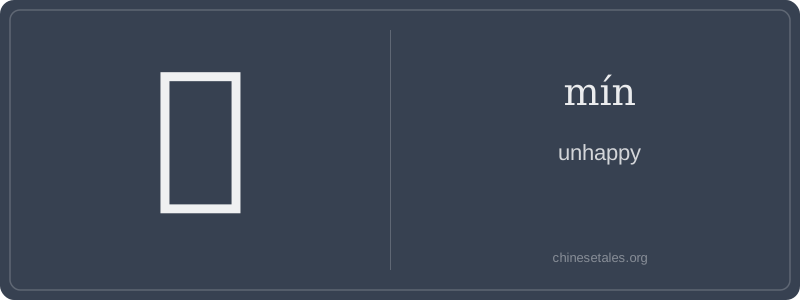
The earliest form of 暋 appears in bronze inscriptions as a combination of 日 (rì, 'sun') on top and 眠 (mián, 'to sleep') — but wait, that’s not quite right. Actually, the bottom was originally 眆 (mǐn), an archaic variant of 眠 meaning 'to close one’s eyes', later simplified to 敏 (mǐn, 'quick-witted'). So imagine the original: 'sun' + 'closed eyes' — not restful slumber, but eyes deliberately shut *against* the light: a visual metaphor for turning away from brightness, refusing to engage. Over centuries, the bottom morphed from 眆 to 敏, then lost its left 'eye' component, leaving just 敏 — giving us today’s structure: 日 + 敏 (13 strokes).
This evolution perfectly mirrors its semantic journey: from physical aversion (shutting eyes to sunlight) → emotional withdrawal (refusing to accept a situation) → moral discontent (a principled frown). The character appears in the *Zuo Zhuan*, where a loyal retainer is described as 暋然不食 — 'sullenly refusing food' in protest against his lord’s injustice. Notice how the 'sun' radical isn’t about time or day here — it’s ironic: the brightest thing in the sky, rejected. That irony is the soul of 暋.
Think of 暋 (mín) as Chinese’s version of the 'resting grumpy face' — not full-blown anger, but that low-simmer, sun-bleached unhappiness you get after three hours in a fluorescent-lit government office. Its core meaning is 'unhappy' or 'discontented', but crucially, it's almost never used alone: it only appears in classical or literary compounds like 暋然 (mínrán) — an adverb meaning 'sullenly' or 'with visible displeasure'. You won’t hear it in daily speech; even native speakers pause and squint when reading it aloud. It’s the linguistic equivalent of finding a vintage typewriter in your modern laptop bag — ornamental, precise, and quietly judgmental.
Grammatically, 暋 behaves like a classical adjective-root, almost always paired with 然 (rání — 'thusly') to form the adverbial pattern X然. So 暋然 means 'in a discontented manner', modifying verbs: 'He stared 暋然 at the bill.' Trying to say 'I am 暋' is like saying 'I am sullenly' in English — grammatically broken. Learners often misread it as mín (like 民), but its tone is *first* tone — think 'mean' without the 'e': 'mīn' (but spelled mín). And yes, it *can* be mǐn in rare phonetic loan contexts (e.g., ancient rhyming poetry), but that’s academic archaeology — ignore it for now.
Culturally, 暋 carries quiet moral weight: in classical texts, it signals disapproval rooted in principle, not pettiness — Confucius might describe a minister who withdraws 暋然 when ritual is violated. Modern learners’ biggest trap? Confusing it with 明 (míng, 'bright') — same radical, similar stroke count, but opposite emotional valence! One shines; the other sulks. Also, don’t force it into casual chat — it’s a haiku word, not a WeChat sticker.