暝
Character Story & Explanation
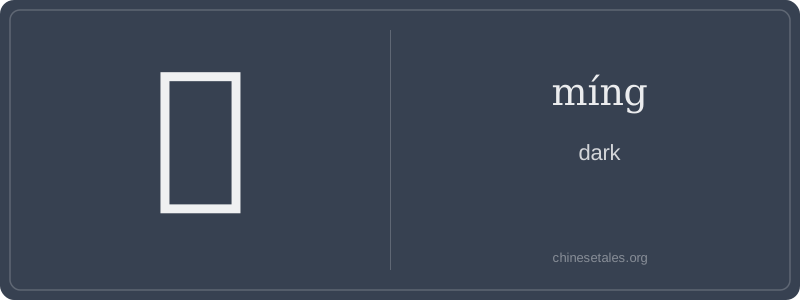
The earliest form of 暝 appears in seal script as a combination of 日 (rì, ‘sun’) on the left and 冥 (míng, ‘deep darkness, netherworld’) on the right. 冥 itself was originally a pictograph of ‘a person under a roof, surrounded by water and clouds’ — suggesting hidden, unseen depths. Over centuries, the right side simplified from 冥’s complex 10-stroke form (冖 + 日 + 六) into today’s streamlined 冖 + 日 + 六 (6 strokes), while the left 日 remained intact. The 14 strokes we write now are a careful balance: 4 for 日, then 10 for the condensed 冥 — visually mirroring the sun descending into deepening shadow.
This character didn’t emerge from daily life but from literati observation: poets like Wang Wei and Meng Haoran used 暝 to capture the exact moment when light softens, colors deepen, and the world grows introspective. In the Tang dynasty anthology *Three Hundred Tang Poems*, 暝 appears in lines like ‘返景入深林,复照青苔上’ — where the returning light pierces deep forest gloom, making 暝 not mere absence, but a luminous, textured presence. Its visual structure — sun + deep darkness — isn’t contradictory; it’s dialectical: the sun doesn’t vanish, it *enters* the dimness, transforming it.
Imagine standing at the edge of a mist-shrouded mountain valley at dusk — not pitch black, but that deep, hushed, velvety blue-purple dimness when daylight surrenders and stars haven’t yet pricked through. That’s 暝 (míng): not just ‘dark’ as in absence of light, but *twilight’s quiet gravity* — poetic, atmospheric, and deeply literary. It’s never used for a dark room or a power outage; you’d say 黑 (hēi) for that. 暝 lives in classical poetry, calligraphy scrolls, and solemn place names — it carries weight, stillness, and a touch of melancholy.
Grammatically, 暝 is almost always a noun or adjective in fixed, elegant phrases: 暝色 (míng sè, ‘twilight hues’), 暝烟 (míng yān, ‘dusk mist’), or as a standalone noun meaning ‘the hour of dusk’. You won’t find it in verbs like ‘to darken’ (that’s 暗下来 àn xià lái) or in casual speech — trying to say ‘It’s getting míng’ will confuse native speakers. It’s a character that insists on context: it belongs in a Tang dynasty poem, not a WeChat message.
Culturally, 暝 evokes the Daoist and Chan Buddhist reverence for liminal moments — thresholds between day/night, awareness/dream, self/emptiness. Learners often misread it as ‘mǐng’ (like 名) or confuse it with 明 (míng, ‘bright’) — ironic, since they’re semantic opposites sharing the same pronunciation! Remember: 日 (sun) + 冥 (deep darkness) = the sun sinking into profound dimness. It’s not everyday vocabulary — but once you spot it in a poem or temple inscription, you’ll feel the hush it brings.