暮
Character Story & Explanation
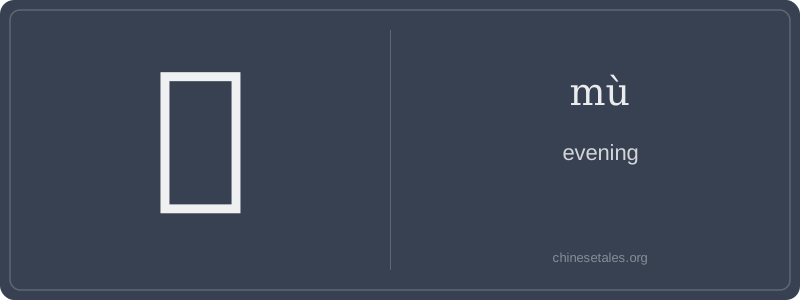
The earliest form of 暮 appears in bronze inscriptions as a vivid scene: the sun (日) sinking behind thick, swaying grass (later stylized as 艸, then simplified to 艹 at the top of 莫). That original pictograph showed daylight disappearing into vegetation — a visceral image of dusk. Over centuries, the grass evolved into the 艹 radical atop 莫, while the sun remained proudly centered above, now as the 日 radical. By the seal script era, the structure stabilized: 日 + 莫 (itself a compound of 艹 + 日 + 大), making 暮 a ‘double-sun’ character — one visible, one hidden.
This visual logic shaped its meaning: not just ‘evening’, but the *process* of the sun’s concealment — a concept deeply embedded in classical Chinese thought. In the Book of Songs, lines like ‘日之夕矣,羊牛下來’ (As the sun descends, sheep and cattle return) echo 暮’s quiet inevitability. Its presence in phrases like 暮鼓晨钟 (evening drum, morning bell) reflects monastic timekeeping — where 暮 marks not a moment, but a threshold between activity and rest, light and reflection.
Think of 暮 (mù) as Chinese poetry’s ‘golden hour’ — not just clock-time, but a mood: hushed, tender, tinged with melancholy and beauty, like the moment in a Renaissance painting when light slants low across a quiet courtyard. It doesn’t mean ‘6 p.m.’ or ‘dinner time’ — it evokes the *quality* of evening: fading light, cooling air, gathering stillness. You won’t see it in casual speech (‘What time is it?’ uses 几点了), but in literature, song lyrics, and formal writing — it’s where emotion lives.
Grammatically, 暮 is almost never used alone. It appears in compound nouns (e.g., 暮色, 暮年) or as a poetic modifier — often in fixed phrases or classical-style expressions. Learners mistakenly try to say ‘It’s evening’ as *‘Shì mù le’* — but that’s unnatural; native speakers say ‘Tiān kuài hēi le’ (The sky’s about to get dark) or use compounds like ‘mù sè jiàn nóng’ (evening hues deepen). It functions like an adjective-noun hybrid: you don’t ‘do’ evening — you *observe*, *enter*, or *are enveloped by* it.
Culturally, 暮 carries gentle pathos — it’s the sigh before nightfall, linked to aging (暮年 = late life), endings (暮春 = late spring), and impermanence. A common trap? Confusing it with 木 (mù, ‘wood’) or 幕 (mù, ‘curtain’) — same sound, wildly different meaning and shape. Remember: 暮 always has 日 (sun) on top — because evening is literally *the sun descending into grass* (the bottom 莫 part).