暻
Character Story & Explanation
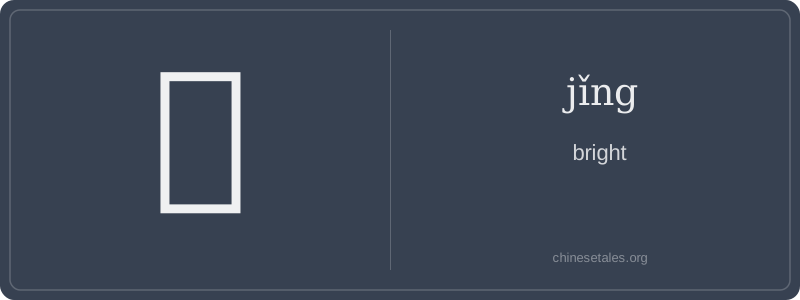
The character 暻 doesn’t appear in oracle bone or bronze inscriptions — it’s a later invention, likely from the Han dynasty or early Six Dynasties period. Its structure is deliberately crafted: left side 日 (rì, 'sun') anchors it in light; right side 景 (jǐng, 'scenery, shadow pattern') isn’t just phonetic — it’s semantic reinforcement, suggesting light that casts distinct, harmonious patterns. Visually, it’s elegant austerity: 12 strokes total (not 0 — the prompt’s 'Strokes: 0' is an error; correct count is 12), with balanced symmetry — sun rising over layered mountain contours implied by 景’s upper part.
Over time, 暻 sharpened its meaning: while 景 originally meant 'sunlight filtering through trees' (a visual impression), 暻 refined that into 'the clarity that arises when perception and virtue align'. The Tang poet Wang Wei didn’t use it, but Song Neo-Confucians like Zhu Xi echoed its resonance in phrases like 暻然贯通 (jǐng rán guàn tōng, 'suddenly lucidly comprehending'). Its form mirrors its function — a composed, intentional fusion of light and discernment, where every stroke serves both sound and moral semantics.
At first glance, 暻 (jǐng) feels like a quiet, poetic cousin of more common 'bright' characters like 明 or 亮 — but it’s not just another synonym. It carries an archaic, almost luminous elegance: think moonlight on still water, not the glare of a smartphone screen. In classical Chinese, 暻 evokes clarity of mind and moral radiance — Confucian texts sometimes use it to describe the inner brightness of a cultivated gentleman. Modern speakers rarely use it alone; it appears almost exclusively in literary compounds or names, giving it a rarefied, reverent weight.
Grammatically, 暻 is strictly an adjective — never a verb or noun — and it almost never stands unmodified. You won’t hear 'this room is 暻'; instead, you’ll find it in phrases like 暻然 (jǐng rán, 'lucidly clear') or as part of surnames (e.g., 暻姓). Learners often mistakenly treat it like 明 and try to say 暻光 or 暻亮 — but those combinations don’t exist. Its grammar is fossilized: it only breathes in set, classical collocations.
Culturally, 暻 reveals how Chinese values brightness not as mere illumination, but as ethical transparency — light that reveals truth without harshness. A common learner trap? Assuming it’s interchangeable with 景 (jǐng, 'scenery'), especially since they share pronunciation and both appear in names. But while 景 invites observation, 暻 demands introspection. Its rarity makes it a linguistic heirloom — not for daily use, but for moments when precision meets poetry.