昙
Character Story & Explanation
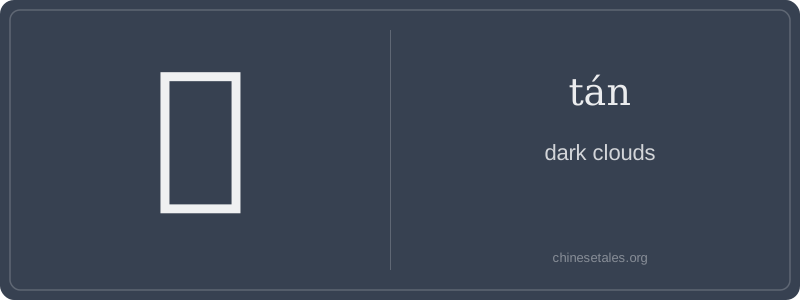
The earliest form of 昙 appears in seal script (c. 3rd century BCE), where it was already a compound: the top half resembles 云 (yún, 'cloud'), stylized as three wavy horizontal lines; the bottom is 日 (rì, 'sun'), but crucially — inverted. Yes, the sun is upside-down! In oracle bone and bronze inscriptions, this inversion wasn’t symbolic poetry — it was practical: scribes carved downward strokes more easily, so the 'sun' radical was rotated to fit the cloud above. Over centuries, the cloud simplified from three curves to two dots and a horizontal stroke (⺈ + 一), while the inverted 日 hardened into the familiar square shape — eight strokes total, each one a quiet rebellion against celestial order.
This visual paradox — sun beneath cloud, yet sun upside-down — crystallized its meaning: not just 'cloudy', but 'clouds obscuring the sun's proper place'. By the Han dynasty, 昙 appeared in texts like the Shuōwén Jiězì as 'yīn yún' (shaded clouds), and by the Tang, poets used it to evoke melancholy beauty — Li Bai wrote of 'tán yún bù kāi' (gloomy clouds refusing to part), linking meteorology to emotional stasis. The inverted sun remains its secret signature: a reminder that in Chinese writing, even weather reflects cosmic harmony — or its delicate, beautiful disruption.
At first glance, 昙 (tán) feels like a quiet, moody character — literally 'dark clouds gathering', but it’s almost never used alone in modern speech. It’s a poetic fossil: you’ll rarely hear it in daily conversation, yet it appears with elegant weight in literary phrases and compound words like 昙花 (tán huā, 'epiphyllum' — the 'night-blooming cereus', whose fleeting flower symbolizes transience). Its core vibe is 'ephemeral gloom': not stormy chaos, but the hushed, heavy stillness before rain, or beauty that vanishes at dawn.
Grammatically, 昙 functions almost exclusively within compounds — never as a verb, adjective, or standalone noun in contemporary usage. You won’t say 'The sky is tán'; instead, you’ll say 昙天 (tán tiān, 'overcast sky') or 昙云 (tán yún, 'gloomy clouds'). Learners sometimes mistakenly try to use it predicatively (e.g., *今天很昙), but that’s ungrammatical — it needs a partner. Think of it like 'gloom' in English: we say 'a gloom settled', not '*it gloomed heavily'.
Culturally, 昙 carries deep resonance through its most famous compound: 昙花一现 (tán huā yī xiàn, 'the epiphyllum blooms once'). This idiom evokes profound Buddhist and Daoist ideas about impermanence — a flash of brilliance that exists only for hours. Many learners misread it as 'tan' (like 'tan line'), but the tone is second (tán), matching 'talk' — a gentle, rising breath, like clouds lifting just enough to let light through.