曌
Character Story & Explanation
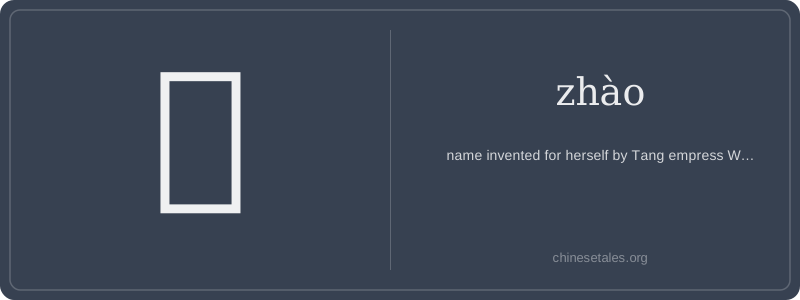
The character 曌 has no ancient oracle bone or bronze script ancestry—it was born fully formed in the Tang dynasty court. Wu Zetian commissioned scholars to design it around 690 CE as part of her imperial legitimization campaign. Visually, it fuses three elements: 日 (rì, sun) on top, 月 (yuè, moon) below it, and 空 (kōng, sky/emptiness) at the base—creating a vertical triad suggesting celestial dominance. Unlike naturally evolved characters, 曌 was engineered: its structure is symmetrical, balanced, and deliberately iconic—like a royal crest. The sun and moon face each other across the central void, their light merging into the boundless sky beneath—a visual metaphor for harmony through supreme control.
Its meaning never broadened beyond Wu Zetian’s self-identification. Classical texts like the Old Book of Tang record it as her ‘self-named character’, used only in official proclamations, stele inscriptions, and posthumous references. Poets later invoked it allusively—e.g., Li Bai’s line ‘曌光临九域’ (‘The light of Zhào shines upon the nine realms’)—but always as a reverent epithet, never a common noun. The character’s very existence challenges the idea that Chinese writing evolves organically; here, language bends to history—not the other way around.
This character isn’t just a word—it’s a political manifesto carved in ink. Empress Wu Zetian, the only woman to rule China as emperor in her own right, invented 曌 (zhào) around 690 CE as her personal regnal name—replacing her given name ‘Zhao’ with this newly forged ideograph. Its meaning? Literally ‘the sun and moon shining together in the sky’, symbolizing her unparalleled authority over both yang (sun, male principle) and yin (moon, female principle). It carries no grammatical function—it’s not a verb, noun, or particle. You’ll never see it in modern grammar drills because it appears almost exclusively in historical texts, inscriptions, or scholarly discussions about Wu Zetian herself.
Grammatically, 曌 behaves like a proper noun: it stands alone, capitalized in effect, and never takes measure words, modifiers, or particles like 的 or 了. Learners sometimes try to use it as a generic word for ‘empress’ or ‘ruler’—a serious error. It is *only* Wu Zetian’s name, and even then, only in formal or poetic contexts. You won’t hear it in conversation, nor will you find it in dictionaries as a functional vocabulary item—it’s a lexical fossil, preserved like a royal seal.
Culturally, 曌 embodies linguistic audacity: Wu didn’t just seize power—she rewrote the script itself. That’s why scholars treat it with reverence—and caution. A common mistake is misreading its components as ‘日’ + ‘月’ + ‘空’ and assuming it means ‘sun-moon-empty’. But the bottom component is actually 空 (kōng), yes—but here it functions phonetically and symbolically: ‘sky’ as the boundless realm where sun and moon coexist. Pronouncing it zhào honors the original homophone of her birth name, while visually declaring cosmic sovereignty.