曚
Character Story & Explanation
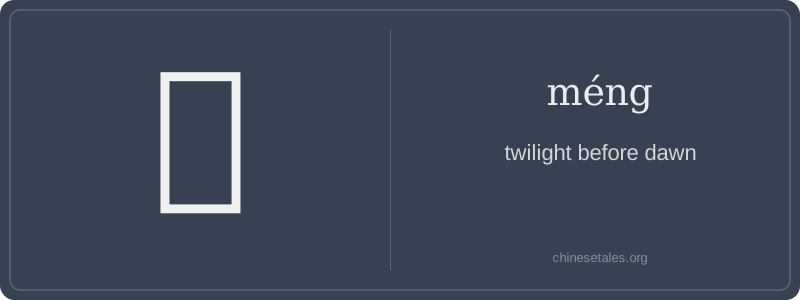
The earliest form of 曚 doesn’t appear in oracle bones — it’s a later creation, born in the seal script era (~3rd c. BCE) as a phono-semantic compound. Its left side 日 (rì, sun) anchors it to celestial time; its right side 蒙 (méng, originally depicting blindfolded eyes under a roof — meaning ‘to cover, obscure’) provides both sound and conceptual weight. Over centuries, the 蒙 component simplified: the top ‘grass’ (艹) and middle ‘eyes’ (冡) condensed into the modern 艹+冡 structure, while the lower ‘water’ (氵) vanished — leaving today’s elegant 18-stroke balance of brightness and veiling.
This visual duality — sun + obscurity — perfectly encodes its meaning: light present but softened, visible but indistinct. Classical poets like Li Bai and Du Fu didn’t use 曚 alone, but its semantic sibling 蒙 appears constantly in descriptions of mist-shrouded mountains or dawn-hazed rivers. By the Tang dynasty, 曚 emerged as the precise, refined term for pre-dawn light — not foggy, not cloudy, but the sun’s first gentle diffusion through the thinning night. Its shape *is* its meaning: the sun, seen dimly, through a veil.
At its heart, 曚 captures a fleeting, poetic moment: that hushed, blue-gray half-light just before sunrise — not quite dark, not yet day. It’s not merely 'dawn' (黎明), nor 'dusk' (黄昏); it’s the world holding its breath in quiet transition. Chinese poets and painters cherish this liminal space — it evokes introspection, anticipation, even melancholy beauty. You won’t hear it in daily chat; it’s literary, atmospheric, and deeply sensory — more felt than functional.
Grammatically, 曚 almost never stands alone. It appears almost exclusively in compound nouns like 曚昽 (méng lóng) or as the first character in poetic phrases (e.g., 曚色, 曚光). It’s an adjective-root, but only in fused, descriptive units — think of it like English ‘gloaming’ or ‘twilight’: rich in mood, poor in conjugation. Learners often mistakenly try to use it predicatively (*‘天很曚’ is unnatural); instead, it lives inside set phrases — 曚昽的月光, not *曚的月光.
Culturally, 曚 reflects the Chinese aesthetic of valuing subtle gradations — not binaries of light/dark, but the profound resonance in between. Confusing it with 明 (bright) or 蒙 (to cover) is common, but 曚 isn’t about concealment or clarity — it’s about luminous ambiguity. Native speakers intuitively sense its soft, diffused quality; learners should treat it like a watercolor pigment: best used sparingly, in layered blends, never straight from the tube.