曰
Character Story & Explanation
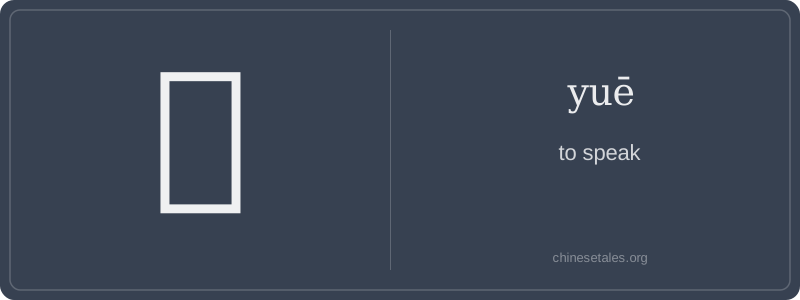
Carved into oracle bones 3,200 years ago, 曰 began as a vivid pictograph: a stylized mouth—rounded like an open oval—with a short line inside representing breath or voice emerging. Over Shang and Zhou bronzes, the oval tightened into a neat rectangle, and the inner line settled firmly horizontal, solidifying the 'mouth uttering words' idea. By the small seal script era, it had become the compact, balanced four-stroke form we use today—every stroke deliberate, every angle precise, as if the character itself were making a formal declaration.
This visual clarity mirrored its semantic rise: 曰 quickly became the go-to verb for authoritative speech—especially divine pronouncements, royal decrees, and sage teachings. In the *Analects*, Confucius ‘says’ (曰) 117 times, each instance marking a pivot in moral reasoning. Unlike casual 云 (yún, 'to say'—used more for hearsay), 曰 conveys direct, intentional, weighty utterance. Even today, its shape echoes that ancient mouth—unblinking, unsmiling, utterly serious—still framing wisdom across millennia of ink and silk.
At first glance, 曰 (yuē) looks like a simple mouth—just a square with a horizontal stroke inside—but don’t be fooled: it’s not the everyday word for 'speak' (that’s 说 shuō). 曰 is the classical, literary verb meaning 'to say' or 'to declare', reserved almost exclusively for quoting speech in ancient texts, philosophical dialogues, and formal inscriptions. It carries gravitas—it’s what Confucius *says*, not what your roommate says about lunch.
Grammatically, 曰 functions like a stately reporting verb: subject + 曰 + quoted words (often without quotation marks in classical Chinese). You’ll see it in structures like '孔子曰' (Kǒngzǐ yuē, 'Confucius said') followed by wisdom, not chit-chat. Learners sometimes misapply it as a synonym for 说 in modern speech—big no-no; using 曰 at a café would sound like you’re reciting oracle bones over your bubble tea. Also, note that 曰 is never used in compound verbs (no *yueshuō* or *yuehua*)—it stands alone, dignified and unblinking.
Culturally, 曰 anchors China’s textual tradition: it’s the verbal hinge of the Analects, Mencius, and bronze inscriptions. Its rarity in spoken Mandarin makes it a linguistic time capsule—and a telltale sign of text authenticity. A common slip? Confusing its clean square shape with 日 (rì, 'sun'), which lacks the internal horizontal stroke. Remember: 曰 speaks; 日 shines—and if you mix them up, you might accidentally claim 'the sun said' instead of 'he said'!