朁
Character Story & Explanation
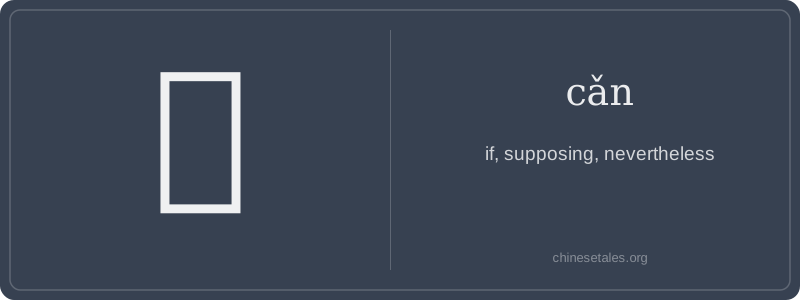
The earliest form of 朁 appears on late Shang oracle bones as a complex pictograph: a mouth (口) beneath a stylized roof or canopy (represented by a horizontal line with downward strokes), flanked by two symmetrical ‘hands’ (-like forms) holding up a vessel — possibly a ritual wine cup. Scholars believe this depicted a ceremonial act of *offering under acknowledged constraint*: hands presenting sacrifice *even though* conditions were unfavorable — hence the seed of ‘supposing/nevertheless’. Over centuries, the roof simplified into 曰 (a mouth-shaped frame), the hands fused into the left-side 旡-like component (now written as the top-left ‘⺈ + 一 + 丿’), and the vessel morphed into the lower 口, yielding today’s 12-stroke structure.
By the Warring States period, 朁 had shed its ritual imagery and crystallized as a logical particle in texts like the *Guodian Chu Slips*, where it introduces concessive clauses in moral arguments. Mencius never used it — but the obscure *Yi Zhou Shu* did, pairing it with words like ‘天命’ (Mandate of Heaven) to express cosmic irony: ‘朁天不佑,吾道益坚’ (‘Even though Heaven does not aid us, our Way grows firmer’). Its visual austerity — balanced, closed, framed by 曰 — mirrors its semantic function: a self-contained, almost ritual pause before paradox.
Let’s crack 朁 (cǎn) like a linguistic puzzle — it’s rare, ancient, and delightfully odd. At its core, 朁 doesn’t mean ‘if’ in the modern conditional sense (like 如果), nor does it mean ‘nevertheless’ like 然而. Instead, it’s a classical adverbial particle expressing *hypothetical concession* — something like ‘even if’, ‘supposing that’, or ‘though indeed’. Think of it as the literary cousin of 虽, but with extra gravitas and zero presence in spoken Mandarin. You’ll only meet it in pre-Qin texts, Han dynasty inscriptions, or poetic allusions — never in textbooks or daily chat.
Grammatically, 朁 always appears at the beginning of a clause, modifying the entire proposition that follows: 朁知其不可,犹为之 (‘Even knowing it was impossible, he still did it’). Note how it doesn’t take a verb or connect two clauses like modern conjunctions — it hangs there, austere and absolute, like a raised eyebrow before fate unfolds. Learners often misread it as 曾 (céng, ‘already’) due to visual similarity, but 朁 has no temporal meaning whatsoever — confusing them turns a philosophical sigh into a grammatical hiccup.
Culturally, 朁 is a fossilized whisper from early Chinese logic: it signals intellectual humility before uncertainty — not ‘what if?’, but ‘*even granted that…*’. Its rarity makes it a subtle status marker: spotting it shows you’ve wandered beyond HSK-land into bamboo-slip territory. And yes — it’s pronounced cǎn, like the word for ‘grim’, which feels oddly fitting: this character doesn’t soften reality; it confronts it head-on, with quiet, unblinking gravity.