朊
Character Story & Explanation
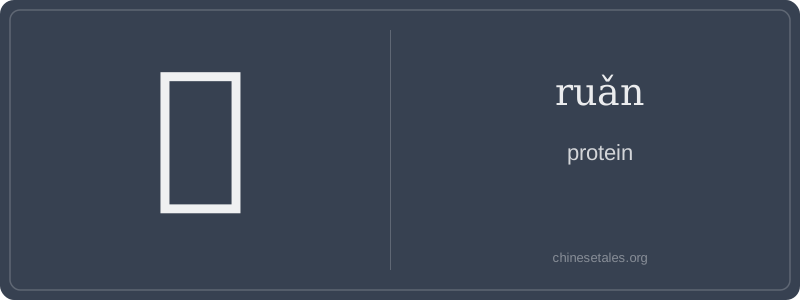
Forget oracle bones — 朊 has no ancient pedigree. It was invented around 1920–30 by Chinese scientists translating ‘protein’ from English. They didn’t adapt an old glyph; they engineered one. Starting from ⺼ (a simplified form of 肉, ‘flesh’, originally a pictograph of hanging meat cuts), they added 元 — not as a phonetic (though it *does* provide the ‘ruǎn’ sound via historical tone shift), but as a semantic anchor meaning ‘primordial’, ‘elemental’. Stroke by stroke: first the left-side flesh radical (⺼, 3 strokes), then 元 — dot, horizontal, vertical, hook, dot (5 strokes), totaling eight. The shape feels balanced, almost cellular: dense left, open right.
The meaning leap is elegant: in classical texts, 元 meant ‘the beginning of heaven and earth’ (《易经》), and ⺼ embodied vitality and substance. When fused in the Republican era, they created a term that resonated with traditional cosmology — protein wasn’t just chemistry; it was the ‘primordial flesh’, the vital origin of bodily form. No classical text uses 朊, but its conceptual DNA echoes Daoist ideas of jīng (essence) and Confucian reverence for the body as a vessel of virtue — now reimagined through a microscope.
Let’s crack 朊 like a forensic linguist: it’s a modern scientific coinage (early 20th century), not an ancient character — and that’s key. Its radical ⺼ (‘flesh’ or ‘body’) screams biological substance, while the right side 元 (yuán, ‘origin’, ‘primary unit’) hints at foundational molecular structure. So literally: ‘the fundamental unit of flesh’. That’s protein — not just any organic compound, but the essential building block of life itself. You’ll almost never see 朊 alone; it only appears in technical compounds like 朊病毒 (prion) or 朊蛋白 (protein).
Grammatically, 朊 is strictly a bound morpheme — it can’t stand alone as a word or noun. You wouldn’t say *‘这很朊’ (‘This is very protein’); instead, it always pairs up: 朊类 (ruǎn lèi, ‘protein class’), 高朊 (gāo ruǎn, ‘high-protein’). It behaves like English ‘-in’ in ‘insulin’ or ‘-ase’ in ‘lipase’: silent without its partner. Learners sometimes misread it as ruàn (mixing up third and fourth tone) or wrongly assume it’s related to 软 (soft) — sound-alike, but zero semantic connection.
Culturally, 朊 is a quiet linguistic time capsule: it reflects how Chinese absorbed Western biochemistry by forging new characters rather than borrowing transliterations. Unlike many loanwords (e.g., 咖啡 for ‘coffee’), 朊 was *designed* — a deliberate fusion of native components to express a foreign concept with native logic. And here’s the kicker: it’s almost exclusively used in academic, medical, or food-label contexts — you won’t hear it on street food stalls or in daily chit-chat. Its rarity makes it a ‘stealth expert’ character: unassuming, eight-stroke, yet loaded with scientific gravity.