朘
Character Story & Explanation
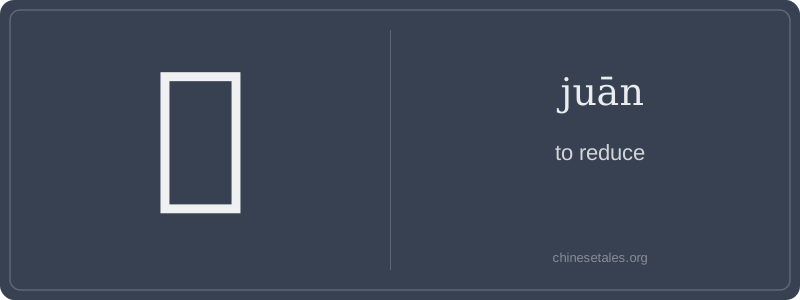
Look closely at 朘: its left side is 月 (yuè), the 'flesh' radical — not the moon! In ancient script, 月 was a stylized depiction of a side view of human flesh or torso, often used in characters related to the body or physical substance. The right side is 夋 (qūn), a phonetic component derived from an ancient pictograph of a person crouching or bending — suggesting contraction, drawing inward, or diminishing posture. In oracle bone script, the earliest form resembled a bent figure pressing against soft tissue — a visual metaphor for compression, shrinking, or wearing down from within. Over centuries, the crouching figure simplified into the angular 夋 we see today, while the flesh radical standardized into the modern 月 shape.
This bodily imagery stuck: by the Warring States period, 朘 appeared in texts like the Guanzi to describe the gradual depletion of vital essence (精气, jīngqì) or state resources. In the Book of Rites, it surfaces in discussions of ritual austerity — reducing excess to restore balance, though still with connotations of loss. The character never shed its somber aura: unlike neutral synonyms, 朘 retained a sense of organic erosion — like bark peeling from a dying tree. Even today, when writers choose 朘 over other 'reduce' words, they’re evoking that ancient, tactile feeling of slow, inevitable diminishment.
Let’s get real: 朘 (juān) is a rare, literary character you’ll almost never hear in daily conversation — but it’s a linguistic time capsule. Its core meaning is 'to reduce' or 'to cut down', but not in the cheerful way of 'cutting costs' — more like 'whittling away at something essential', often with a tone of erosion, depletion, or even moral diminishment. Think of it as the Mandarin equivalent of 'to whittle', 'to sap', or 'to gnaw away'. It carries weight and gravity — you wouldn’t use it for trimming a hedge; you’d use it for describing how corruption gradually 朘蚀 (juān shí) a dynasty’s legitimacy.
Grammatically, 朘 functions almost exclusively as a transitive verb, typically in classical or formal written contexts — essays, historical analysis, or rhetorical criticism. It almost always appears in compounds (like 朘削 or 朘蚀), rarely alone. Learners sometimes mistakenly treat it like common reduction verbs such as 减 (jiǎn) or 缩 (suō), but 朘 is never neutral: it implies irreversible, often harmful diminution. You won’t say '我朘少了工作时间' — that sounds bizarrely archaic and ominous. Instead, it pairs with abstract nouns: power, virtue, resources, authority.
Culturally, 朘 appears most often in scholarly critiques of decline — think late Ming or Qing dynasty essays lamenting moral decay. A common pitfall? Confusing it with 削 (xuē), which also means 'to cut', but lacks 朘’s visceral sense of slow, corrosive loss. Also, watch the pronunciation: while juān is standard for 'reduce', zuī survives only in one ultra-rare dialectal or phonetic variant (e.g., in some old Sichuan folk rhymes), but it’s functionally obsolete — stick to juān unless you’re transcribing a 17th-century local gazetteer.