朾
Character Story & Explanation
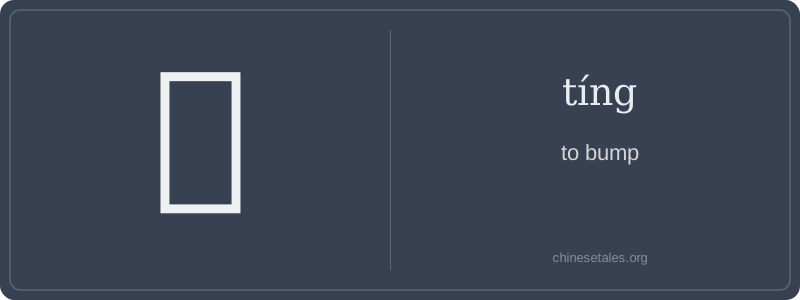
The earliest trace of 朾 appears not in oracle bones, but in Han dynasty bronze inscriptions and early clerical script — where it looks strikingly like two components fused: 木 (mù, ‘tree/wood’) on the left, and 丁 (dīng, ‘nail’ or ‘sturdy person’) on the right. Visually, it’s a wooden post being secured by a nail — or, more evocatively, a nail *driven into* wood. That image of impact — metal meeting timber with a sharp, controlled ‘ting!’ — is baked into its form. Over centuries, the clerical script smoothed the strokes, the seal script emphasized symmetry, and by the regular script era, the wood radical stabilized left, while 丁 became compact and upright — no longer a literal nail, but still echoing force applied to wood.
This origin directly shaped its meaning: 朾 wasn’t just ‘hit’ — it was *controlled impact on wood*, like carpenters testing timber for hollowness, or gatekeepers tapping a wooden post to signal arrival. In the Shuōwén Jiězì (c. 100 CE), Xu Shen defines it as ‘to strike with the hand or tool, producing sound’ — highlighting acoustic feedback. Later, in Tang dynasty poetry, poets used 朾 to evoke quiet, resonant moments: a monk 朾鐘 (tíng zhōng, ‘taps the bell’) at dawn — not ringing it fully, but drawing out a single pure tone. Its visual logic — wood + nail = impact on wood — remained unbroken across 2,000 years.
Let’s be honest: 朾 (tíng) is a linguistic ghost — it exists in dictionaries and classical texts, but you’ll almost never hear it spoken or see it written in modern Chinese. Its core meaning ‘to bump’ or ‘to strike lightly’ feels tactile and physical, like the tap of a knuckle on wood or the gentle nudge of a door against its frame. Unlike common verbs like 碰 (pèng) or 撞 (zhuàng), 朾 carries an archaic, almost poetic weight — think of a scholar tapping a bamboo tablet to check its resonance, not a car crash.
Grammatically, 朾 functions as a transitive verb, typically followed by a noun object (e.g., 朾門 — ‘bump the door’), and it’s nearly always used in literary or dialectal contexts. You won’t find it in HSK textbooks or daily chat apps — it’s absent from the HSK list entirely and doesn’t appear in the People’s Republic’s modern character frequency lists. Learners who stumble upon it in Tang poetry or regional folk records often misread it as 亭 (tíng, ‘pavilion’) due to identical pronunciation and visual similarity, leading to hilarious mistranslations like ‘I bumped the pavilion’ instead of ‘I tapped the doorframe’.
Culturally, 朾 reflects how Chinese preserves semantic nuance across millennia: while modern Mandarin uses broad verbs like 碰, classical Chinese had finely tuned alternatives for specific kinds of contact — light, intentional, resonant, or rhythmic. It’s also regionally alive: in parts of Fujian and Guangdong, elders still use 朾 in oral storytelling to evoke delicate, ritualized touch — like tapping a drum before prayer. The biggest mistake? Assuming it’s interchangeable with more common words. It’s not — it’s a precision tool, not a Swiss Army knife.